Starring: Warwick Davis, Ice-T, Anthony Montgomery
“A friend with weed is a friend indeed, but a friend with gold is the best I’m told.” (Leprechaun, Leprechaun In The Hood)
By the time the Leprechaun series reached its fifth instalment horror’s pint-sized Paddy had already terrorised a young Jennifer Aniston, hunted for a bride, rampaged through Las Vegas and even gone into space. Logic therefore dictated that there was only one place left for him to go – the hood.
It probably goes without saying given the title and the premise, but this film is madder than a caravan filled with seahorses. Rapper-turned-actor Ice-T plays Mack Daddy, a pimp who discovers the Leprechaun in a fossilised state and steals his magic flute, which gives him the ability to enchant anyone who hears it.
Oh, did I mention the Leprechaun also has three demonic fly girls? Well he does
In time Mack Daddy becomes a huge rap star thanks to the flute, but when a trio of young up-and-coming rappers ask him for some help and he “disses” them (as the youth of today say) they break into his house, steal the flute, hide out at a drag queen’s house for some reason then use the flute to kick off their own rap career. Oh, and during all this, the Leprechaun’s come out of his stony state and is ready to fuck up whoever has his flute. Continue reading “Leprechaun In The Hood (2000)”→
Starring: Neve Campbell, Emma Roberts, Courteney Cox, David Arquette, Hayden Panettiere, Rory Culkin
“All there are now are remakes. It’s the only horror studios green-light. I mean, there are still rules, but the rules have changed. The unexpected is the new cliche.” (Charlie, Scream 4)
A lot has changed in horror cinema since the release of Scream 3 back in 2000. Remakes and ‘torture porn’ fims like Saw and Hostel are now the big box-office hits, and new film monsters like Jigsaw and Samara from The Ring are the ones that get today’s teens pulling their covers over their eyes in fear at night.
What’s more, the clever post-modern ideas made popular by Scream – that the characters in the movie reference the rules and situations in other horror movies – are now freely imitated in many of today’s films, with almost every slasher these days containing one wisecracker going on about how you’re never supposed to say “I’ll be right back”, how the black guy always dies first and so on and so forth.
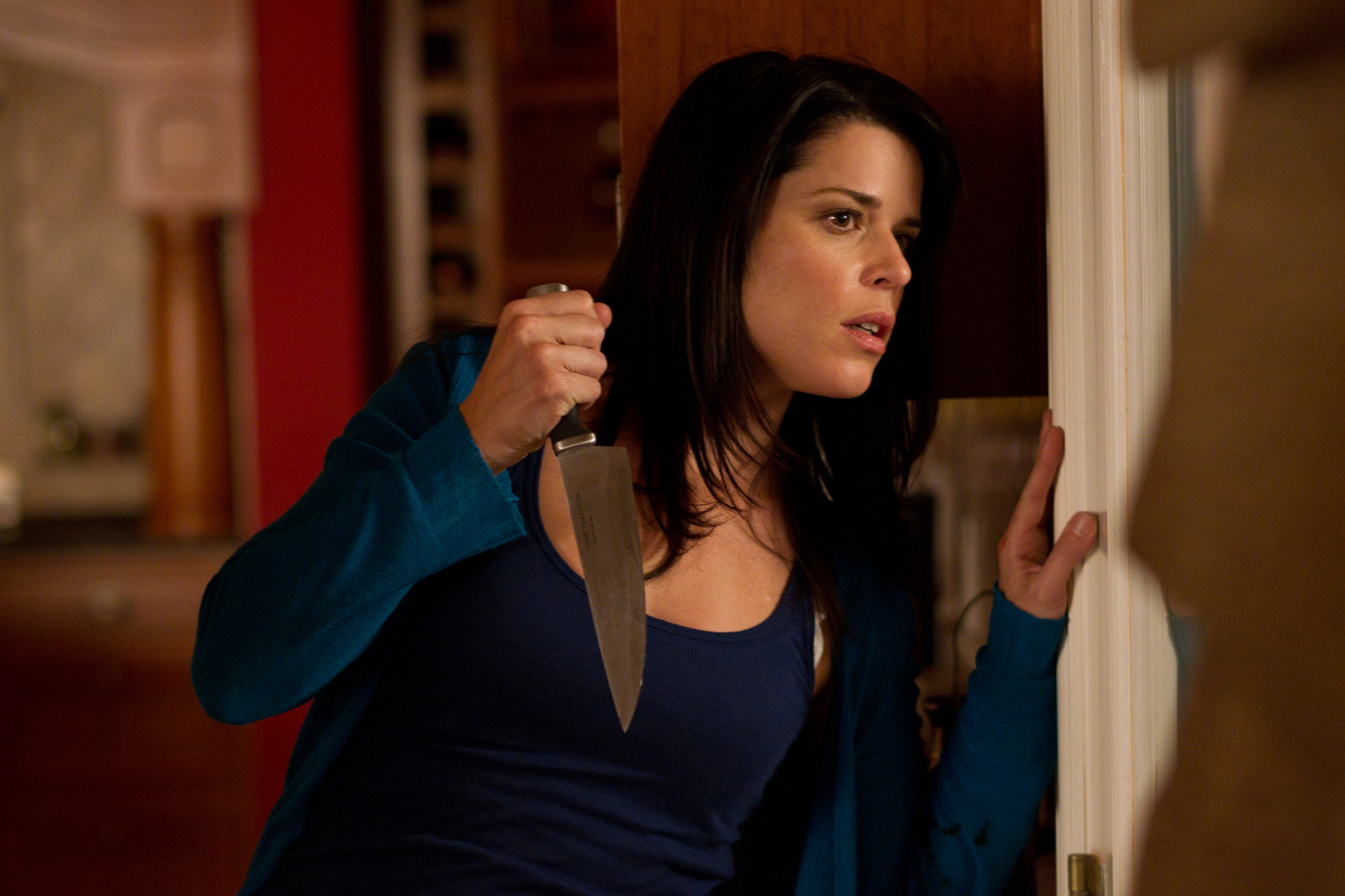
Sidney's fear of steaks made preparing dinner a daily challenge
Scream 4, then, had an uphill battle to be relevant in this new all-knowing, self-referential, nudge-nudge-wink-wink horror landscape, one the Scream series itself essentially created in the first place. It’s impressive, then, that writer Kevin Williamson and director Wes Craven have taken these decade-old characters and ideas and brought them into the 2010s so convincingly, giving them more modern sensibilities but still keeping the elements of what made the original trilogy so popular in the first place.
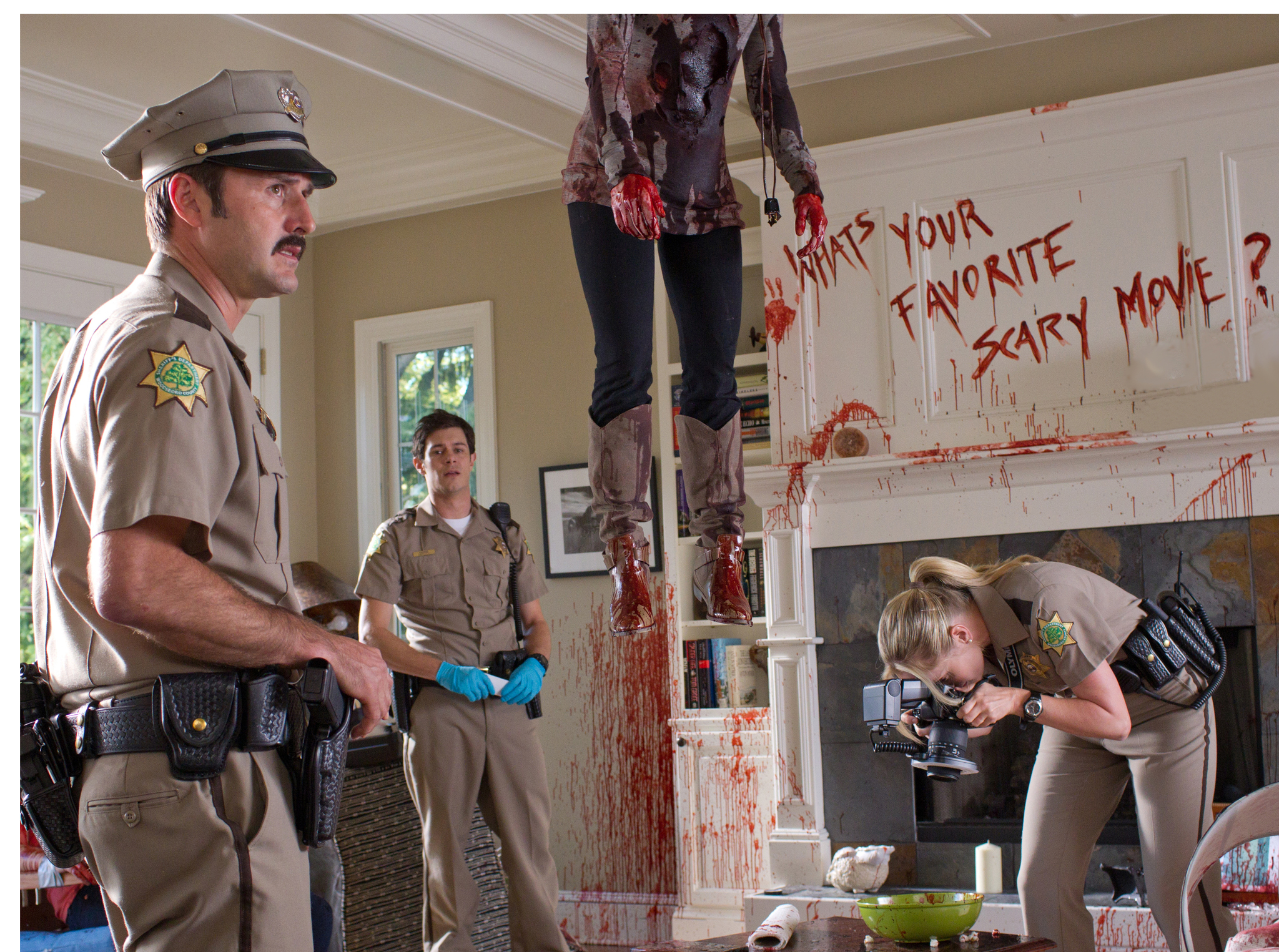
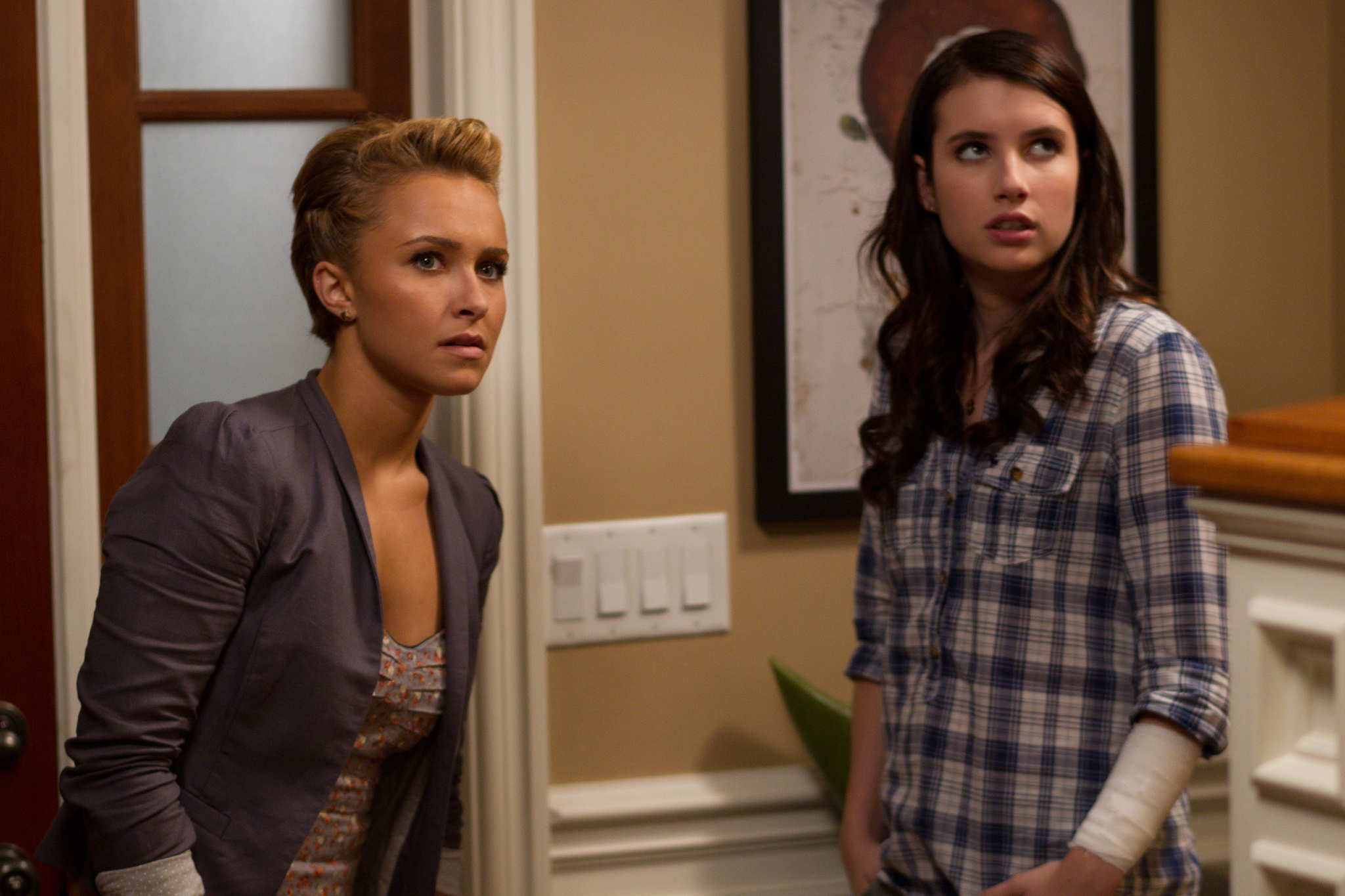
And so the usual “what’s your favourite scary movie” spiel continues, with newer films added to the killer’s trivia repertoire and more graphic threats made over the phone. The killer is made harder to identify now because it’s revealed early on (when someone calls their friend to trick them) that there’s a voice-changing phone app, one that potentially anybody could be using. The film geeks this time are a couple of horror nerds who screen annual movie marathons of the eight Stab films.
The worst forensics squad ever fail to notice the dead body in the room
And yes, those classic ‘rules’ once again return, but this time updated for this new generation with new rules about remakes, which Scream 4 seems to focus most of its criticism on – I wonder if the remake of Craven’s A Nighhtmare On Elm Street had something to do with it. Indeed, the whole third act of the movie, without giving too much away, is very much influenced by the deluge of horror films we’ve seen recently, with one humorous moment in particular seeing a distressed Hayden Panetierre answer one of the killer’s phone questions by screaming out a seemingly endless stream of films that have been remade in the past decade, drawing stark attention to the sheer number of them.
A livid Hayden smells blood as she spots the person who did her hair
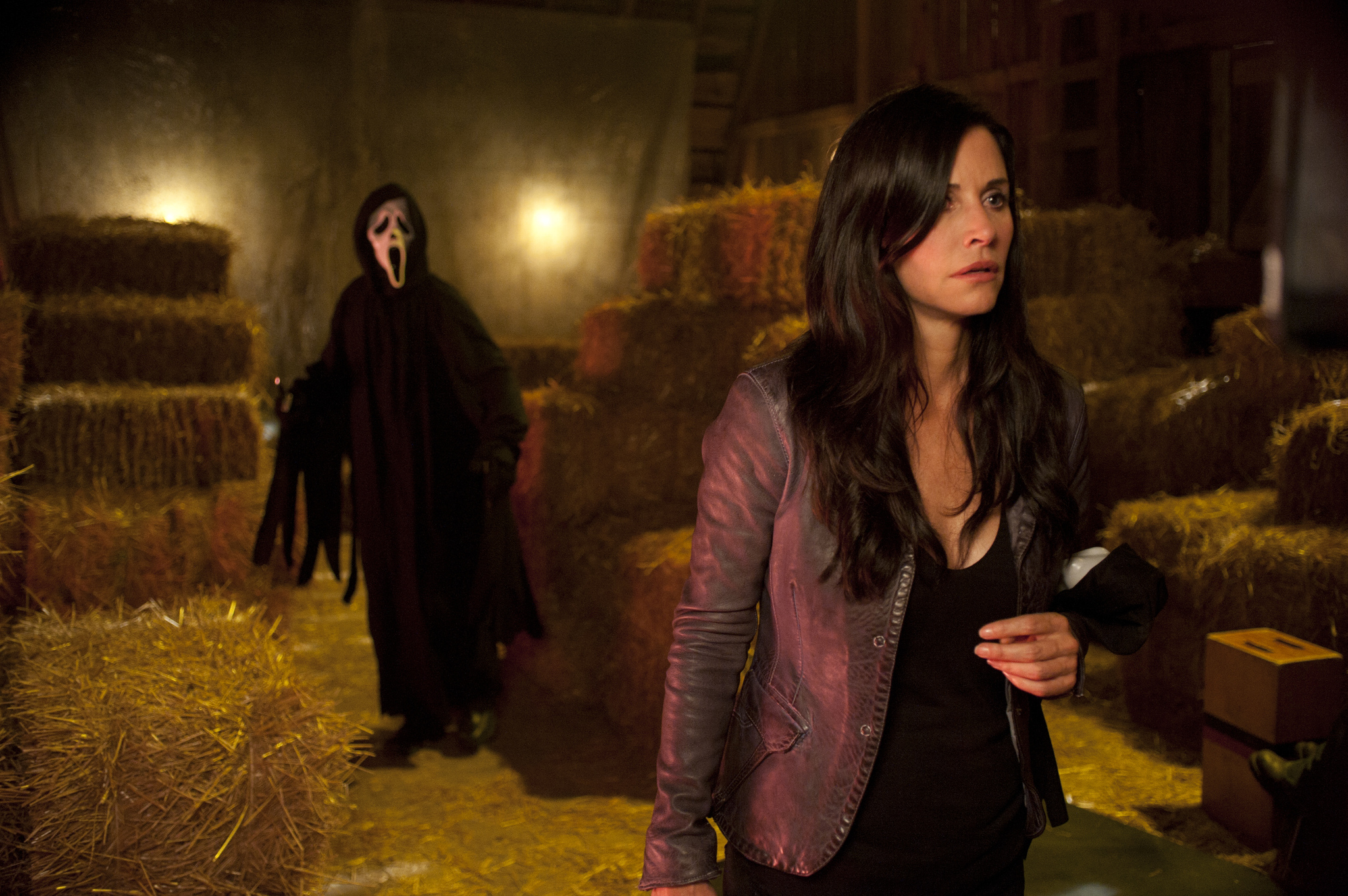
While three cast members from the original trilogy – Neve Campbell, David Arquette and Courteney Cox – all return for Scream 4, it’s perhaps unsurprisingly Cox who steals the show. Campbell is her usual drab, miserably-voiced self, while Arquette’s character seems to have shaken off his permanent limp from the previous film and is now the sheriff, essentially making him a bit of a dick. Cox, however, is hilarious as Gale Weathers, suffering writer’s block as she tries to get back in the spotlight while jealously watching on a Sidney (Campbell) has success with a book of her own and her husband Dewey (Arquette) flirts with his new female deputy. Almost all of the best lines belong to Gale, to the extent that it’s almost exciting to see her turn up in another scene because you know something else is coming. I never thought I’d be praising Courteney Cox as the star in a school play, let alone a film, but fair play to her.
When Bob saw his date waiting for him, he suddenly realised she was joking when she said the party was fancy dress
Of course, it wouldn’t be a Scream film without a whodunit plot, and while the red herrings are perhaps a bit too obvious and clearly overacting to make you think it’s them, the real killer’s identity is a nice twist that actually makes sense and results in a great performance from the cast member in question.
It’s worth pointing out that the final act of Scream 4 does assume some prior knowledge of at least the first film in the series at times, so while it’s not essential I’d recommend you at least go into this one having seen at least the original film (if not necessarily all three) because you’ll get more out of Scream 4’s references, particularly those near the end of the film.
While Scream 4 could never be the revelation and genre-changer the original film was, it still does a great job updating the series to address the changes in horror cinema since the trilogy ended. It’s probably the best of the sequels, and well worth a watch if you enjoyed the first Scream.
Starring: Ryan Kwanten, Donnie Wahlberg, Michael Fairman
“Can you help me with a missing persons case? I’m looking for a male. About this tall. Sometimes seen with a hand up his ass.” (Detective Lipton, Dead Silence)
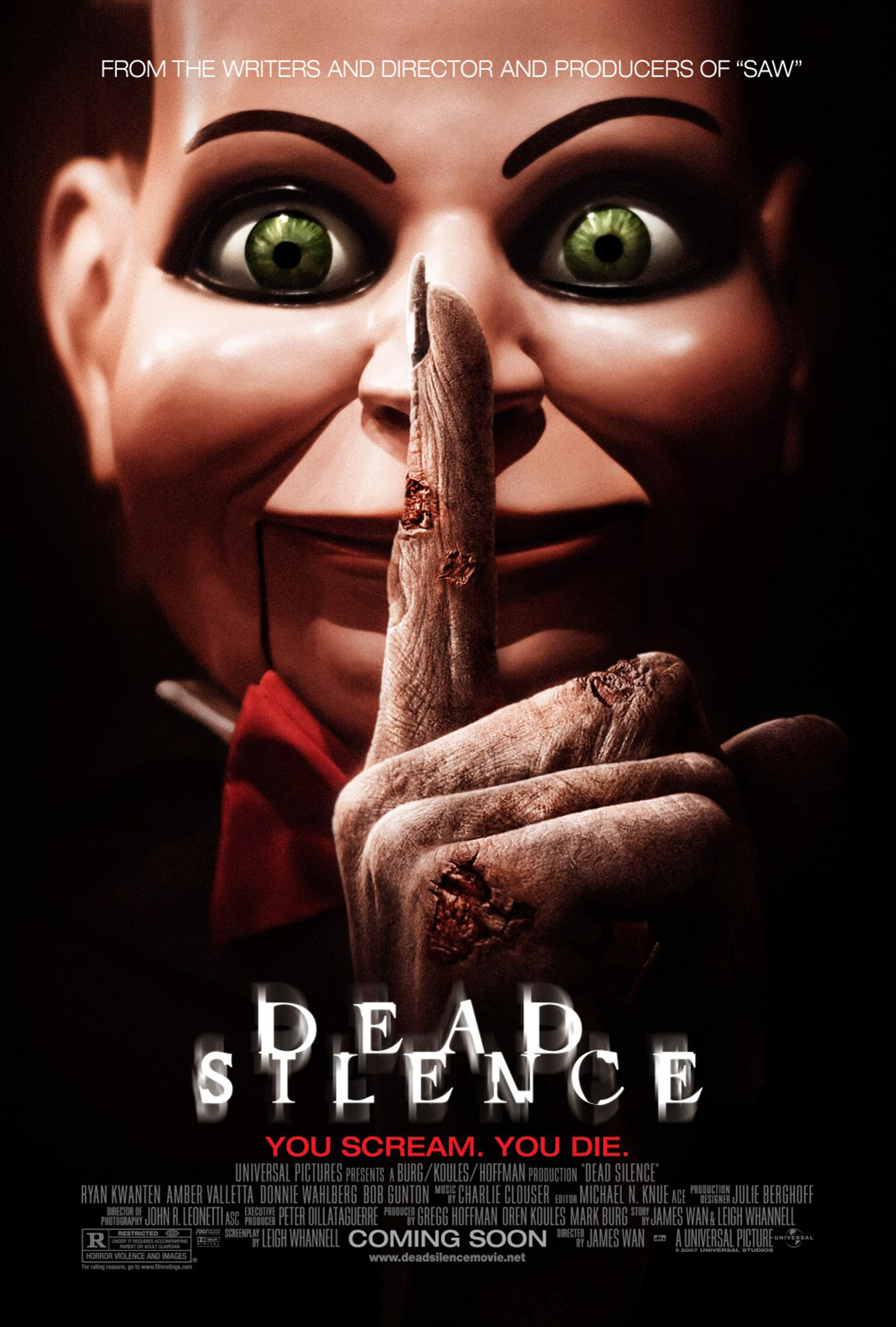
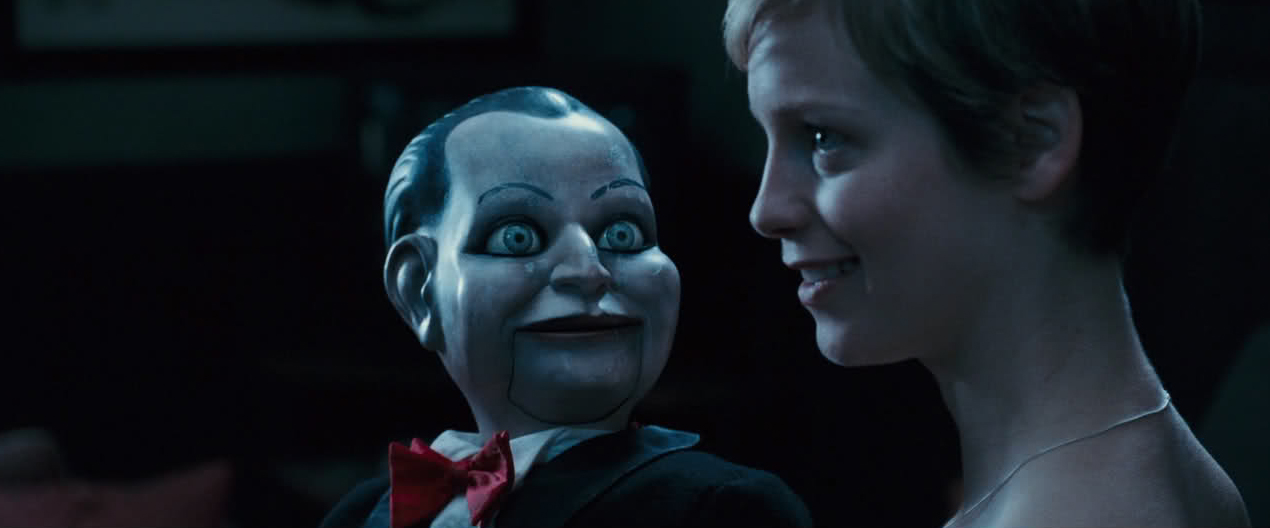
Dolls are creepy, that’s one thing many of us can agree on. Some of them look like they can come alive when you’re not watching. Ventriloquist dummies – those built for the sole purpose of being made to look alive by their owner – are particularly eerie in this respect. I’m certain that’s more or less the sole concept behind Dead Silence, a concept its creators were happy to run with until they realised they actually needed to build a film around it.
"Call me David Cameron again and I'll rip your bastard lungs out"
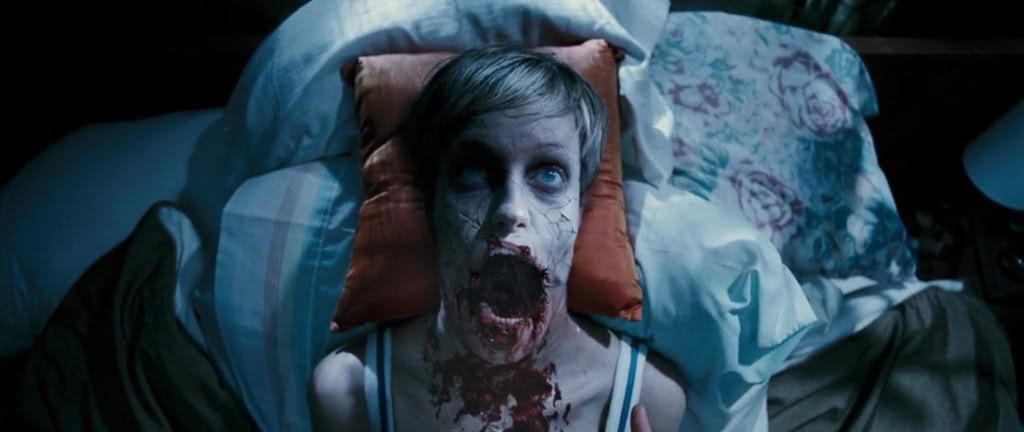
Jamie (Ryan Kwanten) and his wife Lisa are very much in love. As Jamie’s heading off to work he notices that someone has left a mysterious package outside their front door. He opens it to find a ventriloquist’s dummy, with no note explaining who sent it or why it’s been sent to them. Jamie decides he’ll figure it out later and leaves the doll at home with Lisa. When he returns he finds his wife lying dead in bed with her tongue ripped out. Bloody FedEx eh?
It soon emerges that the doll once belonged to Mary Shaw, a famous ventriloquist who was mocked one day in front of a huge audience by a young boy. Shaw kidnapped the boy and he was never seen again, and after realising she’d done it the townsfolk tracked her down and attacked her, ripping her tongue out.
Yes, not content with borrowing from Child’s Play, Dolls and any other killer doll film ever made, Dead Silence also owes a suspiciously large chunk of its plot to A Nightmare On Elm Street with its whole “vigilante parents kill evil child catcher who continues to haunt their children from beyond the grave” plot. Not to mention it even has its own children’s rhyme, though “beware the stare of Mary Shaw” isn’t quite as catchy as “one, two, Freddy’s coming for you”.
Dead Silence is very much style over substance. There is a steady stream of wanky pseudo-arty shots throughout, where maps become wide shots of the road and eyes are zoomed in to reveal an image of the next scene. And no matter how many times they do it (which is a lot), they just can’t seem to make a shot of a doll slowly moving its eyes feel that creepy.
The graffiti on the roof of the London-to-Glasgow sleeper train was too obscene for some passengers
The film has two saving graces. The first is Donnie Wahlberg, who plays the cop following Jamie as he investigates his wife’s murder. Wahlberg’s character is naturally suspicious of Jamie’s claims that the doll killed his wife, and he consistently gets the best lines in the film as he aims snarky and sarcastic comments Jamie’s way as he tries to find evidence that will pin the crime on him.
The other decent aspect is the twist ending, which makes sense and is cleverly handled. You’re likely to have suspicions about the characters in question before the ending is revealed, but it’s unlikely you’d guess exactly what’s been going on. It’s a nice little twist and one that brings a satisfying end to what’s essentially a fairly forgettable film.
“These eyes will deceive you, they will destroy you. They will take from you, your innocence, your pride, and eventually your soul. These eyes do not see what you and I see. Behind these eyes one finds only blackness, the absence of light, these are of a psychopath.” (Dr Loomis, Halloween)
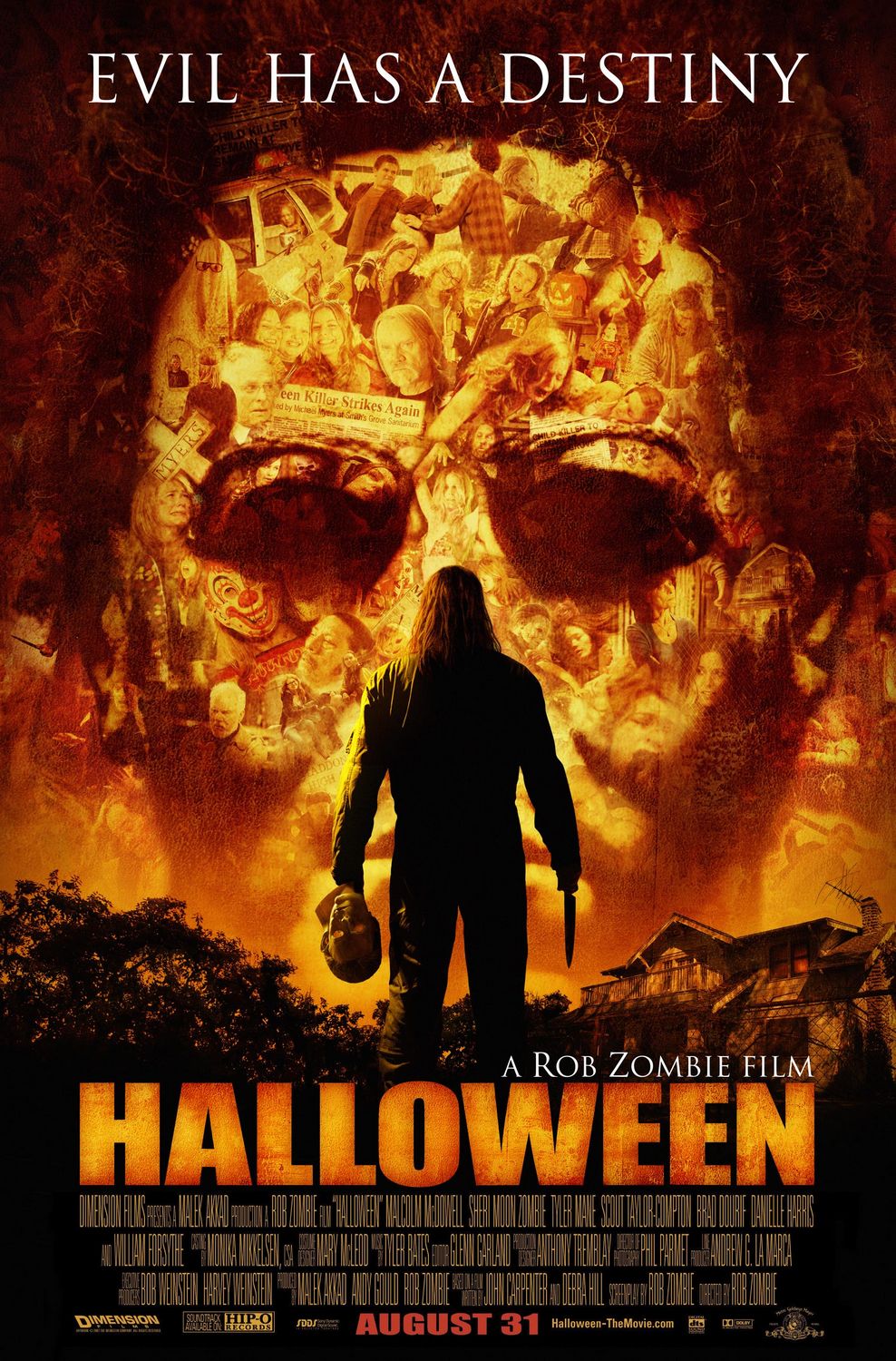
The most effective remakes are not those that simply try to update the original film so it fits in with today’s society and technology, but those that actually attempt to give a unique take on its predecessor and handle the same story in a different way. This is what Rob Zombie’s version of Halloween does, and in doing so it makes it abundantly clear that the filmmaker has an intense respect for John Carpenter’s original.
While the original film focused mainly on Jamie Lee Curtis’s character Laurie Strode and her ordeal throughout the movie, Zombie’s take is very much all about the killer instead. Far more time is spent on Michael Myers – his violent upbringing at the hands of his father, his time at the asylum as he grew up there, his loving mother’s desperate attempts to get through to him and cure him from his psychosis, and his eventual escape years later as a young adult. Rather than going down the “look at what’s happening to this poor girl” route, the message of Zombie’s Halloween is more “look at what this young boy has become”.
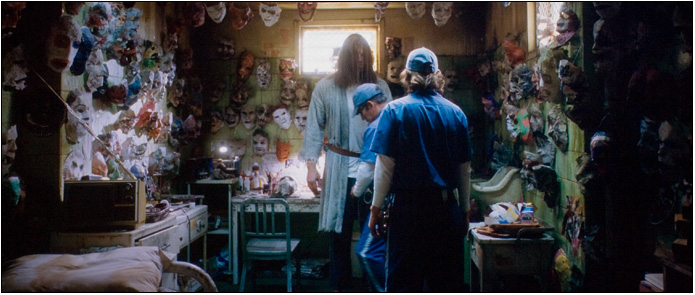
"All these masks and you went with the bleached William Shatner one? No wonder they say you're mental"
This shift of focus isn’t the only difference between the remake and the original, however – Zombie’s version is also far more shocking and visceral. Whereas the few killings in the original film are very ‘clean’, swift and to-the-point, when Myers attacks his victims in the remake it makes for extremely unsettling viewing.
Many films of this generation have similarly grisly and graphic death scenes, but Halloween is impressive in that they never feel glamorised. These killings are raw, they’re shocking. They’re not some big-chested bimbo getting a knife in the tit as she pulls a hammy pained expression, they’re unflinching and realistic – and it’s to Zombie’s credit that they’re presented in this way rather than the ‘torture porn’ many of today’s horror films are accused of offering.
"No you little shit, I'm MALCOLM McDowell. Roddy McDowall was in Planet Of The Apes. I keep telling you this"
The cast for the most part are effective. It would be easy to accuse Zombie of nepotism by casting his wife Sheri Moon as Michael Myers’ mum and also putting his friend Bill Moseley in the film, and it would be similarly simple to suggest the casting of Halloween 4 and 5’s Danielle Harris as one of Laurie’s friends was simply Zombie’s attempt to pander to the fans, but they all put in solid, realistic performances to ensure the film remains as plausible as possible. The addition of strong character actors like Malcolm McDowell (playing the Dr Loomis role almost as well as the late Donald Pleasance did) and Brad Dourif as the sheriff makes for some compelling moments too, particularly when the two are in the same scene.
Oddly, the only real negative performance is that of Scout Taylor-Compton as the ‘heroine’ Laurie Strode. Stepping into Jamie Lee Curtis’s shoes is a big enough feat as it is, but she’s barely even able to do the laces up. It’s not a bad job by any means but it’s almost impressive how forgettable she is and how unimportant Laurie becomes because of this. Indeed, this underwhelming version of Laurie is one of the reasons Michael Myers is the key focal point of the remake rather than the terrified babysitter.
"Right, who's covered up my eyeholes with black card again? It's not funny lads, that's health and safety, that is"
It also helps that the Michael Myers in this film is one of the best in the history of the lengthy Halloween series. This guy isn’t just a simple crazed killer, he’s a proper monster in every sense of the word. Played by the 6’9” Tyler Mane he’s simply terrifying to look at, and that’s just in the asylum scenes before he even escapes and finds the iconic white mask and jumpsuit. Once he does pop them on he’s a truly frightening sight, a Myers with obvious strength to back up his intimidating appearance.
Rob Zombie’s Halloween may not boast the effective simplicity of the original film but it almost makes up for it with its rawness. It’s the original story told in a far more aggressive manner, yet one that still clearly holds Carpenter’s classic in high regard. A success.
Starring: Marilyn Burns, Gunnar Hansen, Edwin Neal, Jim Siedow, Paul Partain
“I just can’t take no pleasure in killing. There’s just some things you gotta do. Don’t mean you have to like it.” (The Cook, The Texas Chainsaw Massacre)
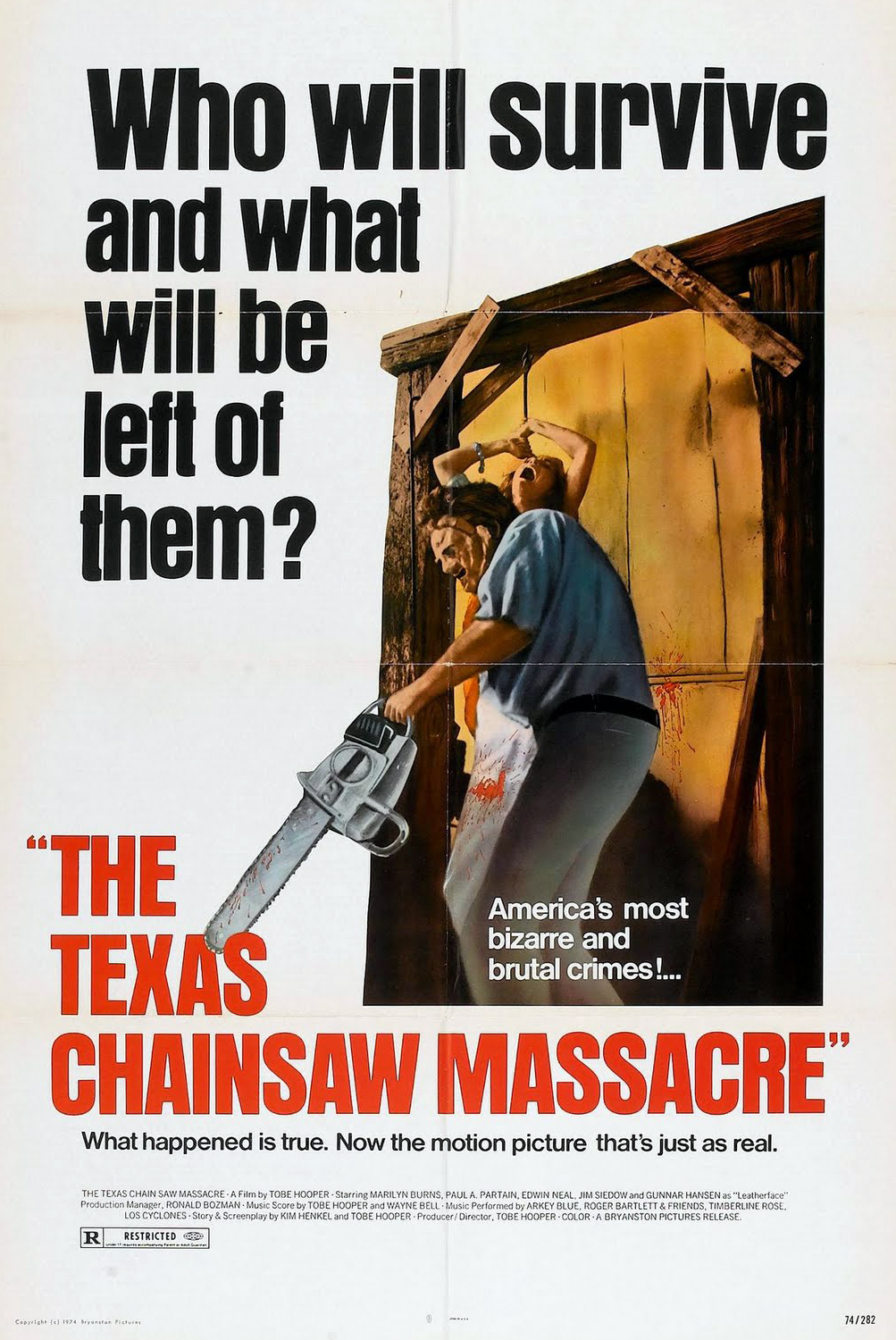
Though it was never technically a video nasty, The Texas Chainsaw Massacre was refused a certificate for a theatrical release by the BBFC and as such remained banned for an astonishing 25 years in the UK. It actually wasn’t until 1999 that the film was finally given an 18 certificate and finally got a British cinema run. Quite a result for a film whose director was initially aiming for a PG rating.
This lengthy ban is particularly interesting when you consider that The Texas Chainsaw Massacre is actually fairly tame by today’s standards, at least in terms of graphic content. Indeed, there’s actually very little on-screen violence at all – instead the film relies on the power of suggestion to terrify audiences. In a way its real downfall was that it worked too well.
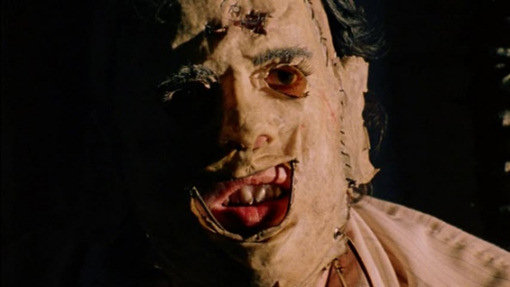
Say what you will about Leatherface, he could give Gok Wan a run for his money with a sewing machine
The film tells the story of Sally, her brother and their three friends who are taking a trip to Texas to stay at Sally’s grandfather’s house out in the countryside. There have been reports that some ne’er-do-wells have been robbing graves, so after a brief stop at the graveyard to check her granddad’s grave is still intact, Sally and chums head on down the road. They pick up a hitch-hiker who turns out to be a bit mental, but it soon turns out that’s just the start of their problems when they happen upon the Sawyer house.
You see, it soon emerges that all the graverobbings have been committed by a weird, possibly in-bred family who live together in a huge country house decorated with their own macabre creations. There are lamps made with human skin, chandeliers made out of bones and armchairs that quite literally have arms on them. That’s what happens when you live too far from an Ikea.
She couldn't believe how bad The X Factor was this year
One by one Sally’s friends discover the Sawyer house while out wandering, and one by one they encounter Leatherface, the huge mentally troubled son of the household who’s taken on the “mother” role. Being the “mother”, Leatherface is in charge of preparing the dinner, and being that the family are a bunch of cannibals, that means capturing his new guests and turning them into that night’s dinner.
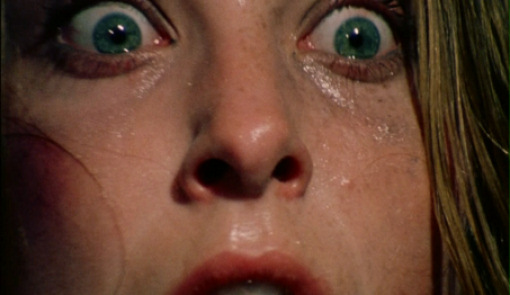
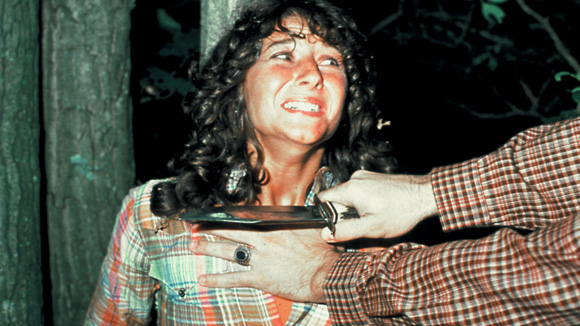
This leads to some of the more infamous scenes in ’70s horror, including one in which a young chap is smacked in the head with a mallet, his legs convulsing as the skull fragments enter his brain. Then there’s the notorious ‘meathook scene’ in which a girl is dragged into the kitchen and literally hoisted up and onto a meathook through her bare back, then writhes around screaming while Leatherface cuts her boyfriend’s head off with a chainsaw.
Bob's Princess Diana joke didn't go down all that well
Incredibly, despite the gruesome descriptions there is very little blood spilled in these scenes. You never see the hammer hit the head, you never see the meathook going in the back, you never see the chainsaw actually touching anyone. Using the same principle that The Human Centipede would copy 35 years later, the film relies on the audience’s ability to fill in the gaps themselves. Whereas actually seeing a meathook pierce the victim may not have worked out so well because the effect could have been hokey and unrealistic (especially given the film’s shoestring budget), by cutting away just before impact the viewer imagines the worst possible outcome in their head and it becomes far more powerful than it ever could have had it been shown.
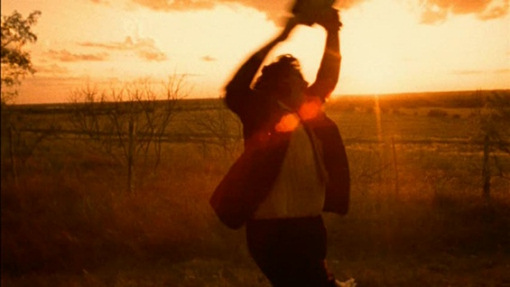
The final scene is almost hypnotic to watch. It's both terrifying and oddly beautiful at the same time
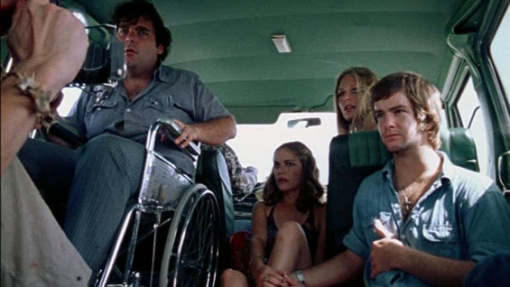
Despite its incredibly low budget (the whole film cost around $83,500 to make) The Texas Chainsaw Massacre is an impressive looking movie at times. It’s clear that director Tobe Hooper (who would go on to do Poltergeist) had a good eye for effective shots at this early stage in his career, and some – such as the van picking up the hitch-hiker and Leatherface’s frustrated tantrum at the end of the movie – are breathtaking.
The cast are also believable too. The five teens each have their own distinct personalities and although it’s clear that Sally and her brother are the main characters and given more opportunity for character development, you can ultimately relate to all five. Meanwhile, the Sawyer family are all as mental as a washing machine filled with bacon and this really comes across well in their performances, particularly Gunnar Hansen as the neglected, scared and yet terrifying Leatherface.
The Texas Chainsaw Massacre is a classic in the horror genre. It may not be to everyone’s tastes, and while it’s tame by today’s standards some many still not like the unrelenting nature of the horror (the final 30 minutes in particular are essentially non-stop screaming, mental torture and noise). If you can stomach the insanity though you’ll find yourself stunned at how such a low budget could produce such an effective film. Essential.
WHERE CAN I BUY IT? British would-be Texas Chainsaw viewers with a Blu-ray player can get the stunning “Seriously Ultimate” edition for less than a tenner by clicking here, otherwise you can get the three-disc DVD by clicking here. Both have the same features (hours upon hours of great documentaries), but the Blu-ray fits it all on a single disc and naturally looks a lot better too.
American peeps, meanwhile, can get the Blu-ray here and the DVD here.
Starring: Neve Campbell, Courteney Cox, David Arquette, Parker Posey, Patrick Warburton, Lance Henriksen
“Is this simply another sequel? If it is, same rules apply. But if you find yourself dealing with an unexpected backstory and a preponderance of exposition, then the sequel rules do not apply. Because you are not dealing with a sequel, you are dealing with the concluding chapter of a trilogy.” (Randy, Scream 3)
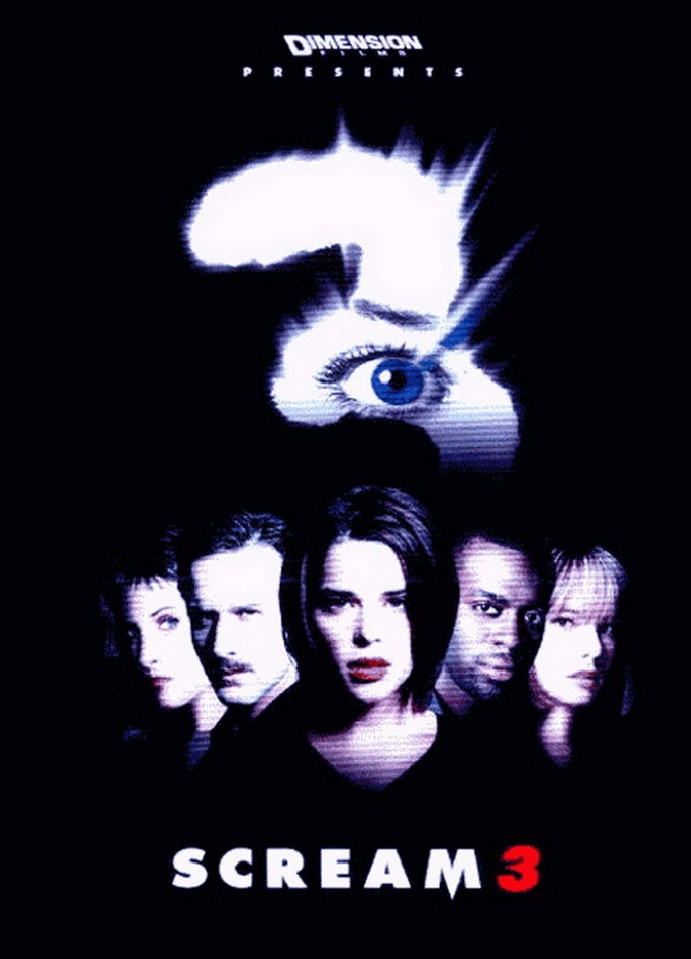
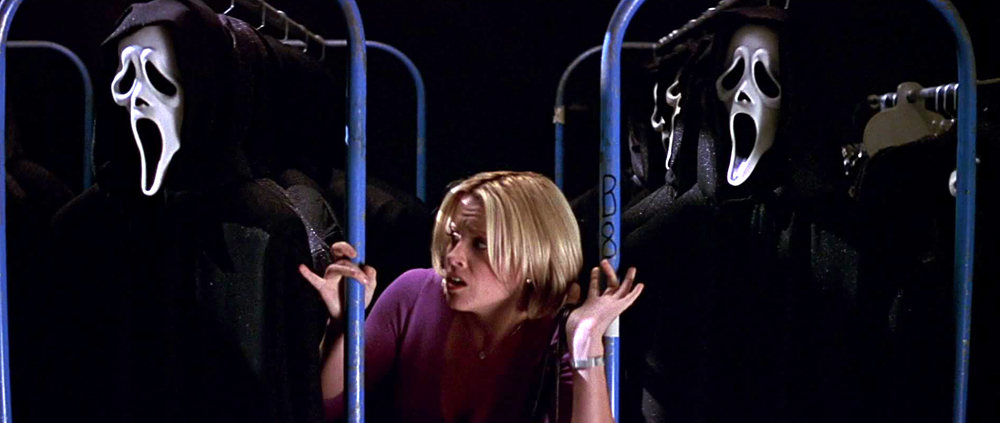
“All I know about movie trilogies is that in the third one, all bets are off”. In a roundabout way, this single line of dialogue attempts to account for Scream 3’s plot but instead sums up everything that’s wrong with it. Gone are the clever references to horror films from the first Scream and the cheeky nods at sequel clichés in its follow-up, replaced by confusing plot points, tired fourth wall references and an ending that’s about as satisfying as using beehives as football boots, with the simple explanation each time that “hey, it’s the third one, we can do any old shite and it’s fair game”.
Sidney couldn't believe the Scottish one had been kicked out of The X Factor
Taking place a couple of years after the events of Scream 2, Sidney Prescott (Neve Campbell) is now living out in the middle of nowhere. Along with her change of address comes a complete change of identity, her name and job altered in an attempt to avoid any more crazed killers who might want to call her up and give her hassle. Ironically, her new job is telephone counselling, in which she helps women over the phone who are suffering from sensitive problems. Guess what happens next?
"I don't care if it's a ghost instead of a woman this time Tiger, you told me you were going to pack this shite in"
The whole “film within a film” thing from Scream 2 is copied again in Scream 3 but it’s taken to the nth degree by setting the majority of the action on the set of the next Stab movie. All the ‘disposable’ characters are actors playing the real-life Sidney, Gail Weathers and the like, making for a silly sub-plot in which the killer is seemingly killing the actors in the same order the real characters died – a sub-plot that mysteriously disappears halfway through the film when the writers seemingly realise that most of the real characters aren’t actually dead yet.
It’s just a mess, really. The instances of humour are clumsy (look, it’s Jay and Silent Bob taking a tour of the film set! It’s real actors playing fake characters in a fake real film set of a fake movie based on fake real events! And look! It’s Carrie Fisher playing a woman who looks just like Carrie Fisher!) the secondary characters have as much personality as a stapler, the blatant shoehorning of Randy into the film – because he was the only interesting character in the previous two instalments – is unsatisfying and the whole thing in general is just underwhelming.
Stella McCartney's winter range was something of an acquired taste
By far the most disappointing aspect, however, is the ending. The whole point of the Scream movies is trying to figure out the identity of the killer and their motive, but when it’s revealed to be one of the least interesting characters in the film and they then go on a boring rant about something or other that nobody really gives a shit about, then Scream 3’s status as a crushingly inadequate end to an otherwise great trilogy is cemented.
My advice is to watch Scream and Scream 2 back-to-back then pretend the third one didn’t exist. As for Scream 4? Well, that’s for another review…
Starring: Neve Cambell, Courteney Cox, Jamie Kennedy, David Arquette, Liev Schrieber, Sarah Michelle Gellar, Jerry O’Connell, Timothy Olyphant
KILLER – “What’s your favourite scary movie?” RANDY – “Showgirls.”
After slicing apart the horror genre and aiming knowing winks at many of its foibles in Scream, some felt that there wasn’t much opportunity to do the same in Scream 2 since so much had been covered already. By its very nature though Scream 2 provided Wes Craven and writer Kevin Williamson a chance to poke fun at one very important aspect of horror films that went unchallenged in the first film – sequels.
Set two years after the events of the first film, Scream 2 sees Sidney (Neve Campbell) at college with a bunch of new vict… um, friends. Sidney’s been getting hounded by the press because of a new movie called Stab, a ‘true story’ based on the events of the first film. As if that wasn’t bad enough, some students have been turning up dead too. Could there be a new killer following in the footsteps of the previous ones? Of course there is, it’s Scream 2.
"It's a good job the killer has a chronic case of narcolepsy," thought Susan
While the clever digs at horror convention and the ‘nudge nudge wink wink’ lines aren’t quite as frequent or obvious as they were in the original film, Scream 2 still has a bit of fun with the genre. The most entertaining dialogue-based scene in the first film – in which Randy teaches his fellow students the rules of horror movies – gets its own follow-up in which, during class, Randy and his peers discuss which movie sequels are better than the originals. Clearly they’ve never seen Return Of The Killer Tomatoes.
Don't be too upset, Ms Cox. Some people just didn't like Friends. Granted, this chap seems to be taking it a little bit too far
Much like in the first film, there are also a bunch of cameos stashed away for eagle-eyed viewers. Some are obvious – the Drew Barrymore role of ‘famous person who dies before the opening titles’ is this time taken by Jada Pinkett-Smith and Omar Epps – whereas others are more subtle. Keep an eye out for Heather Graham, Tori Spelling, Luke Wilson and writer Kevin Williamson all making brief appearances.
The ‘film within a film’ subplot also offers the filmmakers the chance to put the boot into another tired horror cliché, this time one propagated by the media – the copycat killer phenomenon. Wes Craven has covered press attitudes toward horror and its influence before in Wes Craven’s New Nightmare, and he’s no easier on the subject here. It’s claimed by the various new reporters throughout the film that the killer is doing this because they’ve been inspired by the Stab movie, a theory that (while understandable in this case, given the Ghostface mask and the like) is ultimately shot down when their true identity and motives are revealed. Take that, journalists!
The killer isn't a vampire, you stupid mare
Speaking of the ending, it’s underwhelming. While the film – much like the first Scream – is essentially a whodunit, with the audience trying to guess which of the supporting characters is the murderer, the revelation here is nowhere near as shocking as it was in the original movie with the same twist getting churned out again. What’s more, the killers’ identity turns out to be disappointingly predictable, as it turns out the guy who had the evil grin and looked like a killer all the way through the film ends up revealing he was the man behind the mask all along. In fact, he was so blatantly a killer that by the end of the film most audiences will have already passed him off as a red herring because he was too obvious.
Scream 2 is fun. It’s by no means as fresh, as mould-breaking or as engaging as the original film and many of the kills are about as tame as an abused pet (throwing someone off a roof off-screen? Come on), but when a film openly admits in its dialogue that sequels are never better then that should come as little surprise. Check out the first film instead and if you enjoyed that then give this a go, it’ll keep you amused throughout its two-hour duration.
Starring: Jennifer Tilly, Redman, John Waters, voices of Brad Dourif and Billy Boyd
“I’m an Oscar-nominee, for God’s sake. Now look at me, I’m fucking a puppet.” (Jennifer Tilly, Seed Of Chucky)
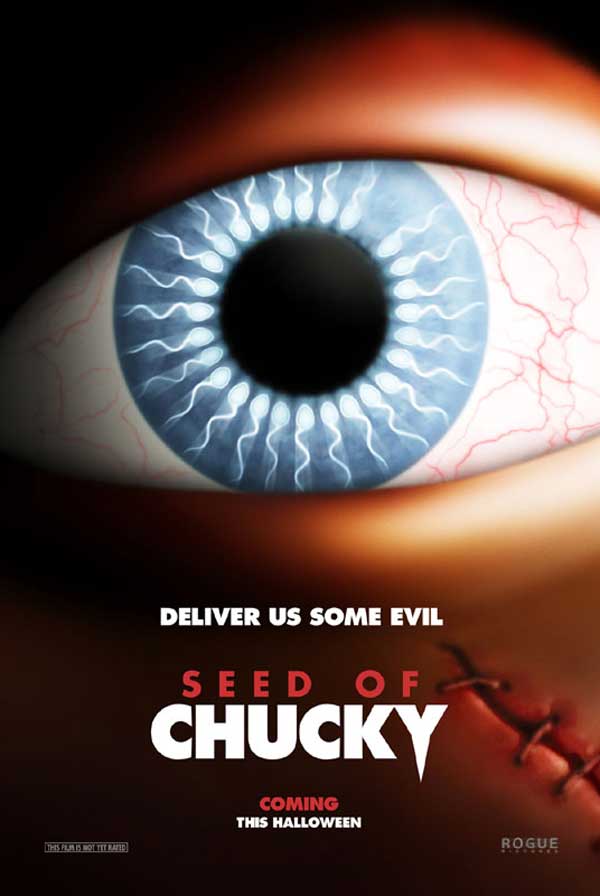
After Bride Of Chucky took the Child’s Play series and injected a much-needed burst of dark humour to proceedings, it would have been impossible for its successor to go back to pure horror. Sure enough, Seed Of Chucky goes even further down the comedy route, only just stopping short of having the characters throw custard pies at one another.
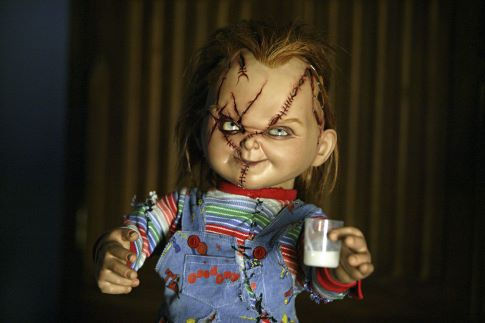
Seed Of Chucky is set in the ‘real world’, a world in which Chucky is just a doll in some daft horror movies. We’re first introduced to a new doll, Glen (voiced by Billy Boyd). Glen doesn’t know who his parents are – can you see where this is going? – but after seeing an on-set report from the latest Child’s Play movie on TV he notices that he shares the same ‘Made In Japan’ markings Chucky has on his wrist.
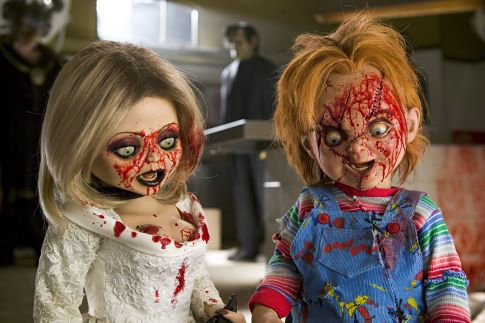
So that's the Seed Of Chucky, is it? Oh.
Glen decides to travel to Hollywood to meet Chucky and Tiffany, his apparently Japanese mum and dad. When he gets there he finds that Chucky and Tiffany are just normal dolls, but after a spot of voodoo (ah, that old chestnut) they’re back to their old selves and ready to carve upLos Angeles, but not before trying to figure out how to raise their son. Or is it their daughter?
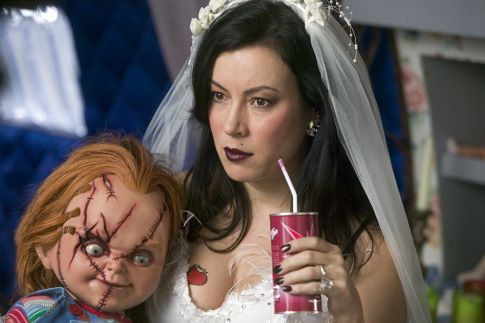
You see, Chucky wants to raise Glen as a killer so he can go on murderous sprees with his old man in the same way other father/son combos would go fishing or watch sports. Tiffany, meanwhile, is adamant that their child is in fact a girl called Glenda (a nod to the Ed Wood cross-dressing classic Glen Or Glenda). The fact that, being a doll, Glen/da doesn’t have any genitalia doesn’t really solve the argument, so Chucky and Tiffany spend the rest of the film competing for the love (and gender) of their offspring.
Her eyes are up there, Chucky
Killer dolls aside, the real star of the show is Jennifer Tilly, not only providing the voice of Tiffany but also playing a caricaturised version of herself in this ‘real world’. This version of Tilly is a desperate B-list actress who was once respected (Tilly was nominated for an Oscar in real life for her performance in Woody Allen’s Bullets Over Broadway) and is now struggling to get all the good roles because they keep going to the likes of Julia Roberts. Throughout the movie Tilly considers sleeping with a director (played by Wu-Tang Clan legend Redman) to get a part, is frustrated when everyone she meets only remembers her from her lesbian scene in Bound and treats her PA like dirt, without realising that she’s the one writing all her so-called ‘fan mail’.
Well, that's what happens when your dog swallows a grenade
She also sticks the boot into herself a few times while voicing Tiffany, who at first is starstruck by Tilly and then begins to lose respect for her (“no wonder her career’s in trouble”). In one scene Tiffany drags an unconscious Tilly across the floor and declares “jeez, she’s fat” – a line many actors would refuse to say, I’d wager, but one that Tilly is game to deliver with refreshing self-deprecation.
After a series of inventive and gory death scenes (cult movie-making icon John Waters getting acid poured on his face, anyone?), the film falls apart a little in the third act as the novelty factor starts to wear off and Glen’s character (the weakest of the three dolls) comes to the fore. It’s a shame, because the first hour is great fun, but much like a French frog it just doesn’t have legs.
Seed Of Chucky is both the goriest and least serious of the five Chucky movies to date. The fact that the upcoming Child’s Play remake is taking the series back to its deadly serious roots shows that Seed was essentially as far as the comedy approach could go, and this shows near the end of the film as the laughs get stretched further and further. Still, it’s not a terrible film by any means, and should at least keep you entertained for most of its duration.
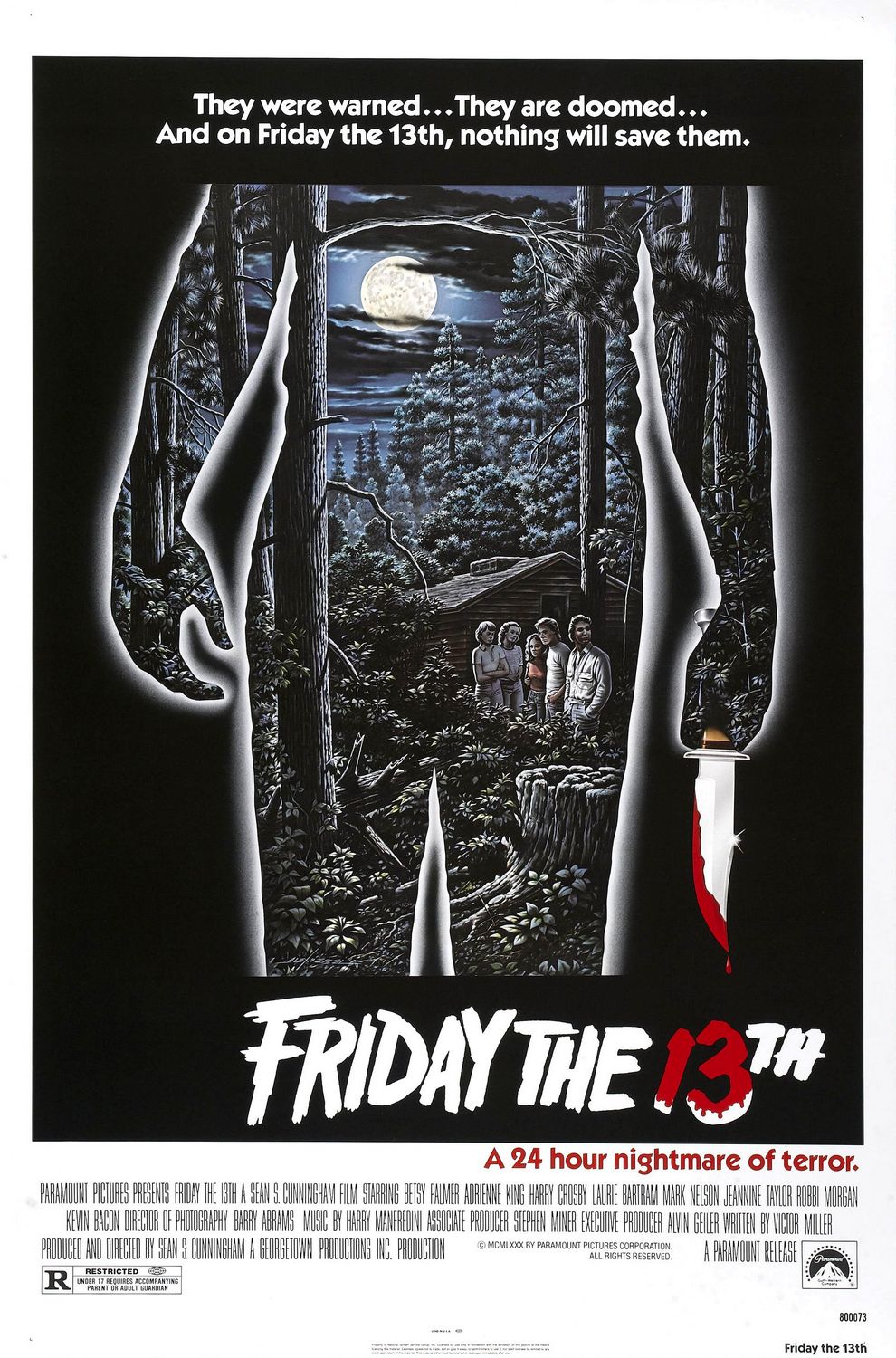
Starring: Betsy Palmer, Adrienne King, Kevin Bacon, Walt Gorney
“You’re going to Camp Blood, ain’t ya? You’ll never come back again. It’s got a death curse!” (Crazy Ralph, Friday The 13th)
You can’t beat a good Jason movie. Not that this is one, of course, because he’s not really in it. And while the reference to Friday The 13th in the opening scene of Scream did its best to inform today’s horror fans that Jason Voorhees was never actually the killer in the original movie, many still believe he’s been the one slicing up teens ever since the series began. They’re wrong. Laugh at them.
Regardless of the big man’s absence Friday The 13th is still a hugely influential film. Much like Halloween inspired the slasher genre in the first place, Friday The 13th was the film responsible for countless imitators in the more specific camp slasher sub-genre. Sleepaway Camp, The Burning, even modern ‘gems’ like Scream Bloody Murder… they all got the original ‘teens at a camp’ idea from Friday The 13th.
Insert your own "splitting headache" joke
The story now sounds clichéd but at the time it was fairly original. 23 years after Camp Crystal Lake closes down following an accident an enterprising young chap decides to open it up again, despite warnings from the locals to leave well alone. As we join the story the counsellors are making their way to the camp early to prepare for the children’s arrival in a few days. But they’re not alone… well, obviously, because the other counsellors are there. What I mean is there’s a killer wandering around too.
As the first important camp slasher movie, Friday The 13th established a lot of the clichés that remain to this day. Gory deaths are a given but it was also responsible for cementing the unwritten rule that if you have sex you die, the subsequent rule that the virgin is the one who’ll become the survivor, and the presence of that camp slasher favourite, the Crazy Old Man™.
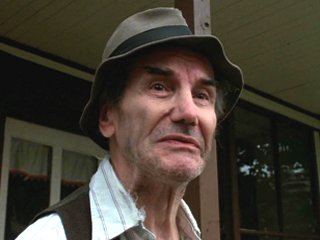
Ralph was right! Who's crazy now, eh? (answer: it's still Ralph)
Friday The 13th’s Crazy Old Man™ is Ralph, an apparent Grade A mentalist who advises one of the counsellors that Camp Crystal Lake has a “death curse” and that they should stay away. Though it’s not a curse as such, the fact that Ralph was right all along and that he’s smart enough to then piss off after his warning so he can survive past the closing credits (in this film, at least) means he’s a credit to Crazy Old Men™ everywhere. Good work, Ralph.
Of course, all the counsellors ignore Ralph because he’s a Crazy Old Man™ and continue on to the camp, presumably because if they’d said “hmmm, sounds dangerous, let’s go back home and get a bar job instead” the film would perhaps have been less exciting and may not have spawned the eleven sequels it did.
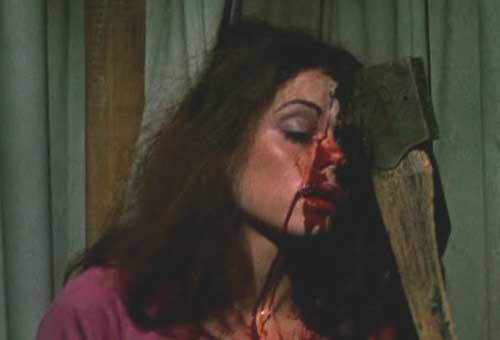
"I'm sorry, all I meant was that for a female killer you've got very hairy hands"
And so, as would soon become traditional, the counselors start getting offed one by one. The deaths surprisingly realistic for a film with such a low budget, mainly thanks to the special effects expertise of a young Tom Savini, who would go on to become a legend of the horror genre with films like Dawn Of The Dead. The most impressive scene of the bunch is the arrow-in-the-neck demise of Jack – played by a 21-year-old Kevin Bacon in his first role – which looks so believable that to this day many are still stumped as to how it was done (though there have been documentaries since that have revealed the secret).
Of course, as is customary in these films the killer has to eventually be revealed, and while I won’t spoil it (in case you’re one of the few people who doesn’t know what happens) it leads to a rather underwhelming final fifteen minutes when you know the killer isn’t exactly the strongest person in the world. Still, the final death and the brilliant twist ending make up for it.
Friday The 13th may be showing its age now and it may not prominently feature the man who would become synonymous with the series but despite this it’s still a great example of the genre at its purest. If you’re relatively new to slasher films and are as a result less likely to be able to tell when the jumps are coming (many films used the Friday The 13th series as templates for the timing of their jumps) then you’ll be in for a scary ride, but for everyone else these days it’s just a dumb, fun movie that happened to give birth to an entire sub-genre. See it.
Starring: Jennifer Tilly, Katherine Heigl, John Ritter, voice of Brad Dourif
Jesse: “How’d you end up like this?” Tiffany: “It’s a long story.” Chucky: “Let me put it this way. If it were a movie, it would probably take three or four sequels to do it justice.”
A lot can change in seven years. When Child’s Play 3 was released in 1991 the idea of a killer doll was still considered scary. By the time Chucky’s fourth film went into production however horror was in its post-Scream phase and slasher films were being taken less seriously when their killers were human, let alone a tiny ginger plastic midget. Chucky would have stood no chance as a convincing horror star anymore had his fourth film stuck to the super-serious Child’s Play formula, so things would have to change.
"Nice work eBay, you bastards... minor imperfections my arse"
And so, rather than following the tried-and-tested “Chucky stalks a young child” routine as seen in the previous three Child’s Play movies, Bride Of Chucky instead became a knowing, tongue-in-cheek, self-deprecating movie that knew audiences wouldn’t take killer dolls seriously anymore and so chose not to take itself seriously either.
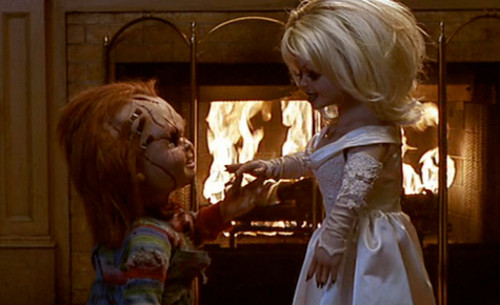
The film opens with Tiffany (Jennifer Tilly), an ex-girlfriend of Chucky’s when he was still a human, tracking down the remains of the Chucky doll and bringing them home. After performing voodoo on the doll and bringing Chucky back to life, she tells him she’s going to help him find a human body so they can finally get married like they’d planned. Problem is there’s been a little misunderstanding and Chucky never wanted to get married, so a dejected Tiffany locks Chucky in a cage, vowing to keep him in his doll form.
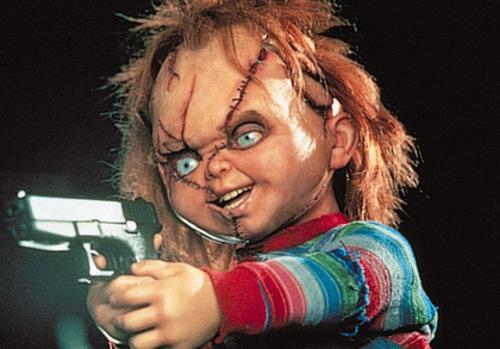
Laugh it up now mate but your hand isn't articulated enough to pull the trigger
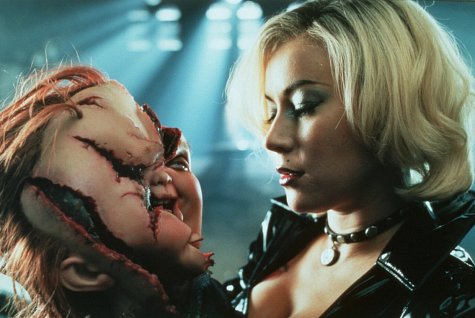
After breaking loose, Chucky decides to give Tiffany a taste of her own medicine and voodoos her soul into the body of a bride doll. The plastic pair grudgingly form an alliance to seek out the corpse of Charles Lee Ray (Chucky’s original form) so they can find the amulet he was buried with and use its power to turn them both human again.
Whereas the Child’s Play trilogy played things out with a stony-faced solemnity as if it were Cape Fear, Bride Of Chucky knows it’s a bit mental and because of this it’s far funnier than Chucky’s previous films. The one-liners come thick and fast and the characters of Chucky and Tiffany play well off each other. They’re an odd couple both literally and figuratively – Tiffany wants a happy home where she bakes cookies for her loving man, while Chucky is a foul-mouthed sleazeball who doesn’t have a romantic bone in his plastic body – so it’s fun watching their personalities clash.
When Mick Hucknall met Debbie Harry, it was awkward to say the least
Humour aside, Bride Of Chucky’s level of violence is also brought killing and screaming into the late ‘90s. At one point being told his traditional knife is “too ‘80s”, Chucky is encouraged to improvise new ways of offing his foes and this results in some interesting kills. Safe to say you’ll never sleep in a water bed, break into a car or step into the middle of the motorway again – though if you do the latter you’re sort of asking for it anyway.
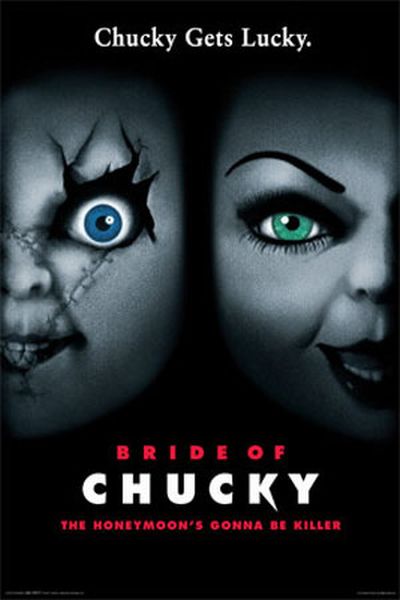
Bride Of Chucky may not be to everyone’s taste but it’s really the best direction the series could have taken. Chucky just wasn’t scary anymore by the time this went into production (though the upcoming Child’s Play remake may change that) and so it’s ultimately better to get audiences laughing with him than laughing at him. With this change in tone, what could have become an ‘80s slasher character long forgotten among the Leprechauns, Critters and Ghoulies of this world is now a cult hero among genre fans, with merchandise up the wazoo and a horde of followers. Bride Of Chucky was a big risk but, as the film’s poster says, Chucky got lucky.

 Director: Rob Spera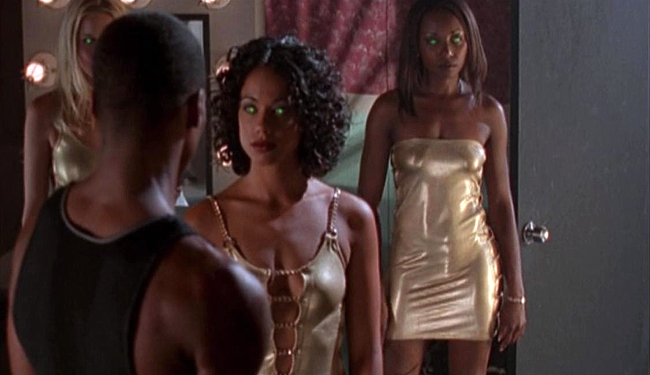



 , otherwise you can get the three-disc DVD
  and the DVD
  .
.




 That Was A Bit Mental