Teen Wolf (1985)

Director: Rod Daniel

Starring: Michael J Fox, Susan Ursitti, Jerry Levine

Harold – “Listen son, you’re going to be able to do a lot of things the other guys aren’t.”
Scott – “Oh yeah, like chase cars and bite the mailman?”

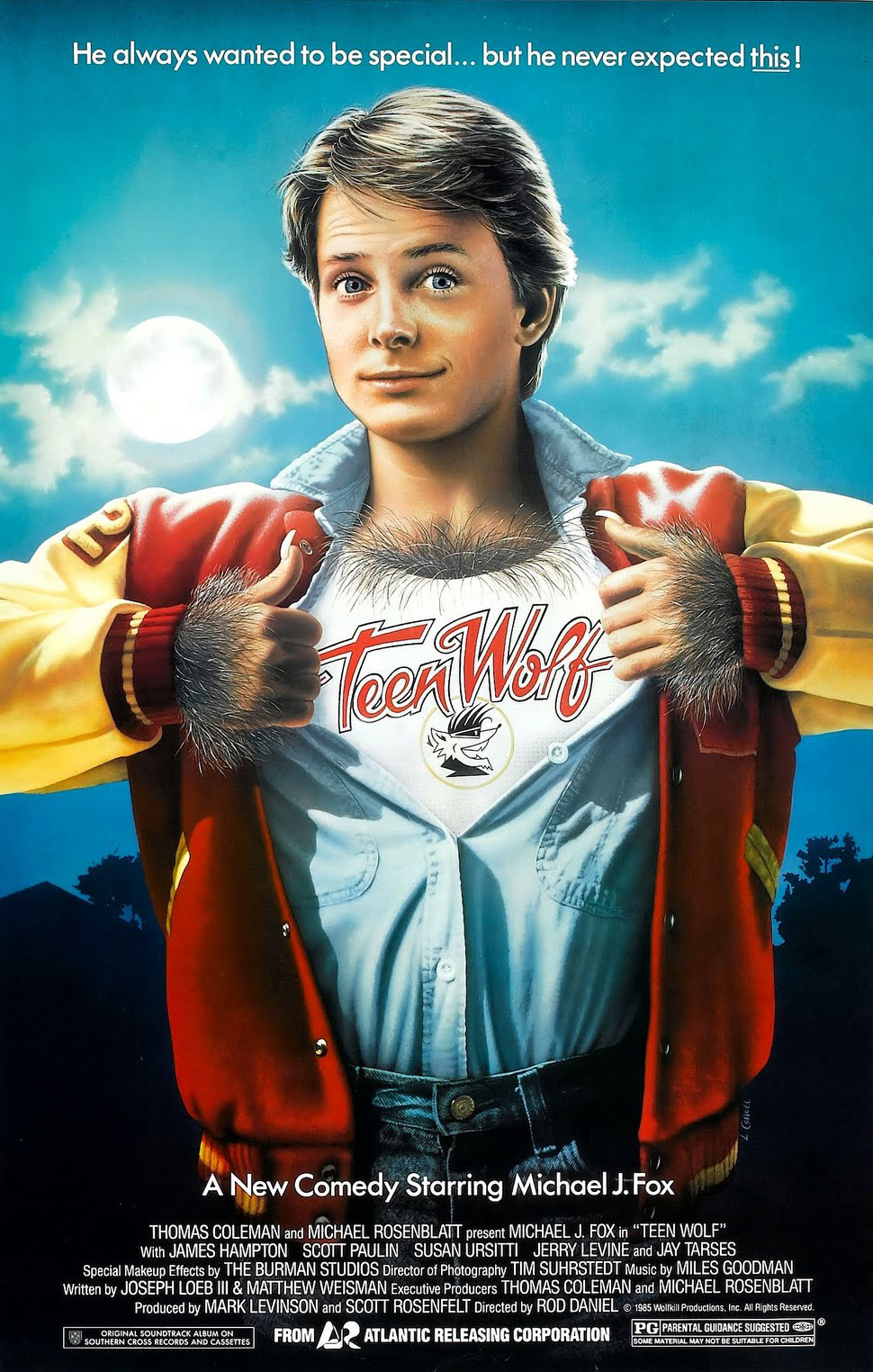
Fresh from his success in Back To The Future, Michael J Fox was the talk of Tinseltown. He was quickly snapped up to play the lead role in Teen Wolf, a teen comedy with “bite”. Ho ho ho, I’m quite the wordsmith.

Scott Howard (Fox) is your typical high school loser. He’s shit at basketball, can’t attract the ladies and can’t buy alcohol because the guy at the liquor store is too smart for him and his pals. In short, he’s a dweeb.

Fun fact - when you turn into a werewolf you look like Clint Howard for a second

Things start to take a turn for the better when Scott all of a sudden realises he can actually play basketball like a young Michael Jordan. His friends are amazed at his newfound abilities and he is too, but he soon gets concerned when he starts growing hair at a ridiculous rate (no, not like that) and finds himself snapping into violent rages all of a sudden.

Eventually Scott’s hair gets out of control and starts to completely cover his face. He locks himself in his bathroom at home, scared at what he’s becoming. His dad comes into the bathroom too and, to Scott’s surprise, his face is similarly fluffy. It turns out  Scott – like his dad and the rest of his bloodline – is a werewolf.
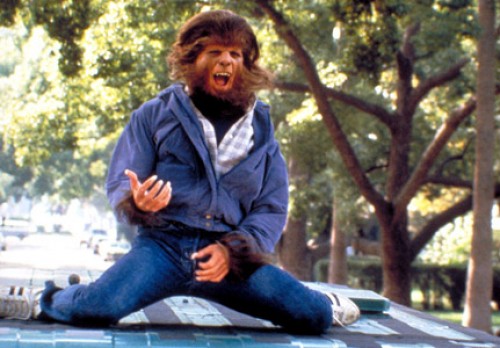
The famous "surfing on the car" scene. Don't try this at home. Unless you're a wolf.

Oddly, despite his new appearance his schoolmates don’t really question it like they would if it happened in real life. Instead, everyone thinks wolfman Scott is awesome. They love his basketball skills, they think he’s cool as hell and all the ladies want to be with him (even though it’s essentially bestiality). The director of the school play wants him to be the lead (as long as he’s still a werewolf) and he gets invited to all the parties.

Even though it’s a film about an odd subject, the same old teen movie conventions apply and it’s ultimately yet another movie about high school acceptance. When he becomes cool, Scott finally gains the attention of the selfish bimbo all the guys love, at the same time ignoring the wholesome, loveable girl who’s actually in love with him. Meanwhile, all his basketball teammates start to resent him because he hogs the ball and isn’t a team player.
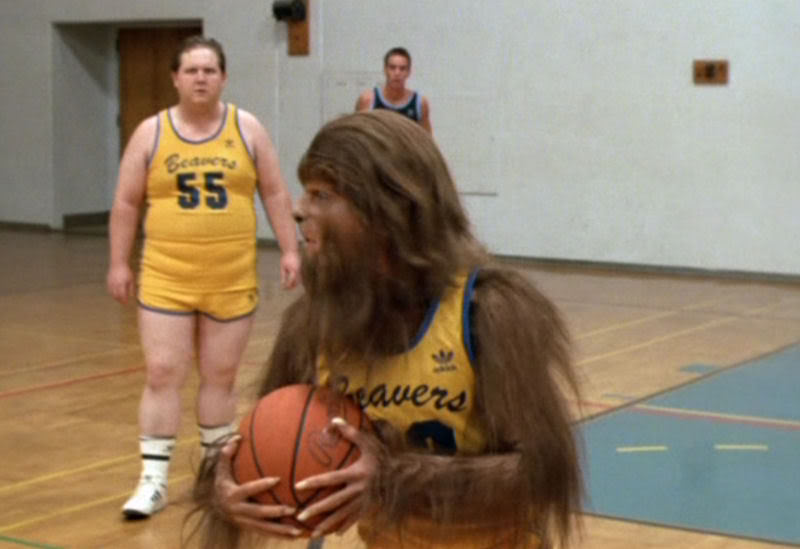
Look! It's the guy who says "look! It's Enrico Palazzo!" in the Naked Gun

As you’d expect, Scott loves the popularity for a while, but then realises it’s a shallow existence. And, as you’d expect, by the end of the film Scott realises being a cool werewolf isn’t all it’s cracked up to be, tries to play basketball without his werewolf powers and realises who’s really important in his life. It’s all predictable stuff.

Eventually the whole werewolf gimmick becomes pointless because the only ability it really seems to give Scott is the ability to play basketball better. Since I’m fairly sure werewolves aren’t known for their ability to play basketball the movie could have just as easily been called Teen Frog or Teen Coat Rack and it would have been the same film with different make-up and special effects.

Teen Wolf is a perfectly acceptable high school movie, but if you’re expecting a movie showing how a teen struggles to survive high school with a hideous medical affliction you’re going to be disappointed because all it essentially teaches is that if you want everyone to love you, you have to be a werewolf first.

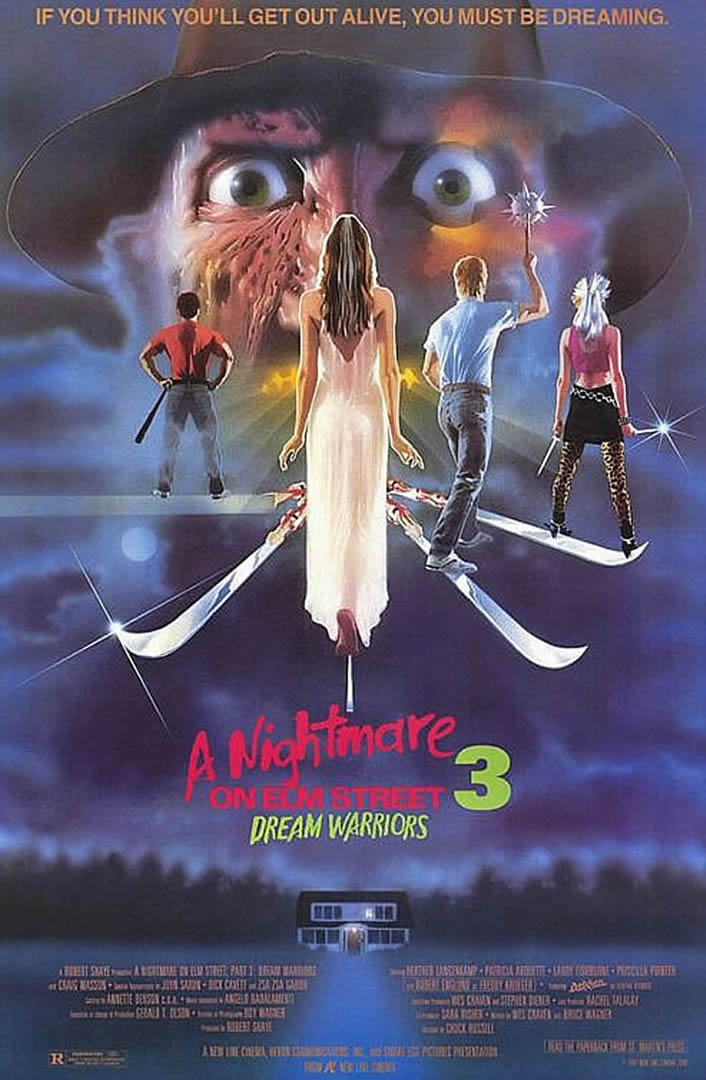
A Nightmare On Elm Street 3: Dream Warriors (1987)

Director: Chuck Russell

Starring: Robert Englund, Heather Langenkamp, Patricia Arquette, Laurence Fishburne, John Saxon

“Let’s go kick the motherfucker’s ass all over dreamland.” (Kincaid, A Nightmare On Elm Street 3)

After New Line Cinema ballsed up the sequel to its biggest-grossing hit with an unintentionally homo-erotic film that tore apart the mythology the original took great pains to create, it was decided that the third Nightmare movie would right the wrongs of Freddy’s Revenge and provide the true sequel Freddy fans wanted the first time around.

Back came Wes Craven, then, who had been shunned for the second film. Craven wrote a first draft of the script then moved on to a different project, but not before also convincing Heather Langenkamp, who played Nancy in the original film, to return. The combination of Craven’s story and Nancy’s return laid the groundwork for what would ultimately prove to be the best of the Nightmare On Elm Street sequels.

This was Patricia Arquette's first big film role. A film where she's eaten by a big snake.

With Elm Street exhausted of teenagers, Dream Warriors moves its setting to a psychiatric hospital where a fresh batch of potential teenage victims are housed. While each of these teens is in the nuthouse for their own personal reasons – one doesn’t talk, one self-harms, another is a drug addict – they also share a common problem: they’re all being stalked in their sleep by Freddy Krueger.

Naturally, the staff aren’t having any of it, and the kids are getting annoyed that their pleas are going unnoticed – that is, until Nancy joins the hospital as a group therapist.

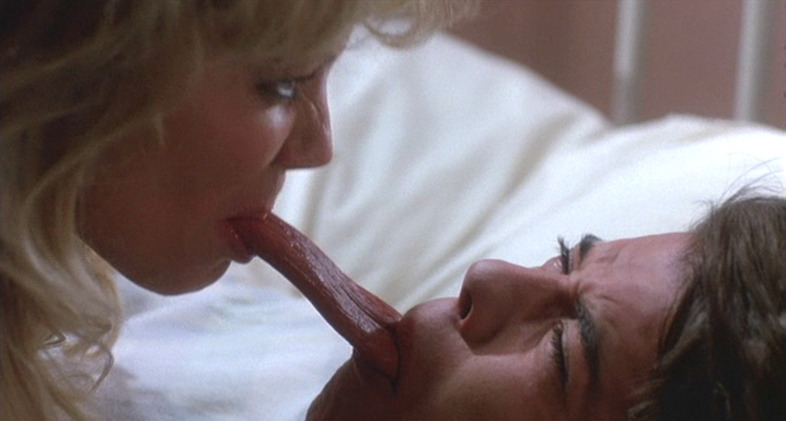
Some said Britney Spears' kissing technique was a little severe

After finding out what they’re all going through, Nancy explains to the teens that they’re the last of the Elm Street children – the kids of the parents that burned Freddy alive – and that he wants to kill them so he can finally get his revenge once and for all. Nancy teaches the group that they’re in control of their own dreams, and that as long as they keep that control they can give themselves any special powers they want to help them defeat Freddy. And so they set about preparing to take on Freddy in the dream world.

The reason Dream Warriors is the best of the Nightmare sequels is because it marks the final high point of the series just before Freddy’s popularity exploded and the Nightmare movies descended into self-parody and MTV jokes. This is the first film where Freddy starts wisecracking as he offs his victims but the actual plot is still somewhat serious – the backstory telling how his mother, a nun at an asylum, conceived him after she was accidentally locked in a room with a hundred maniac inmates and raped over and over verges on the obscene – and ensures the film remains a firm member of the horror genre as opposed to the black comedies its sequels essentially were.

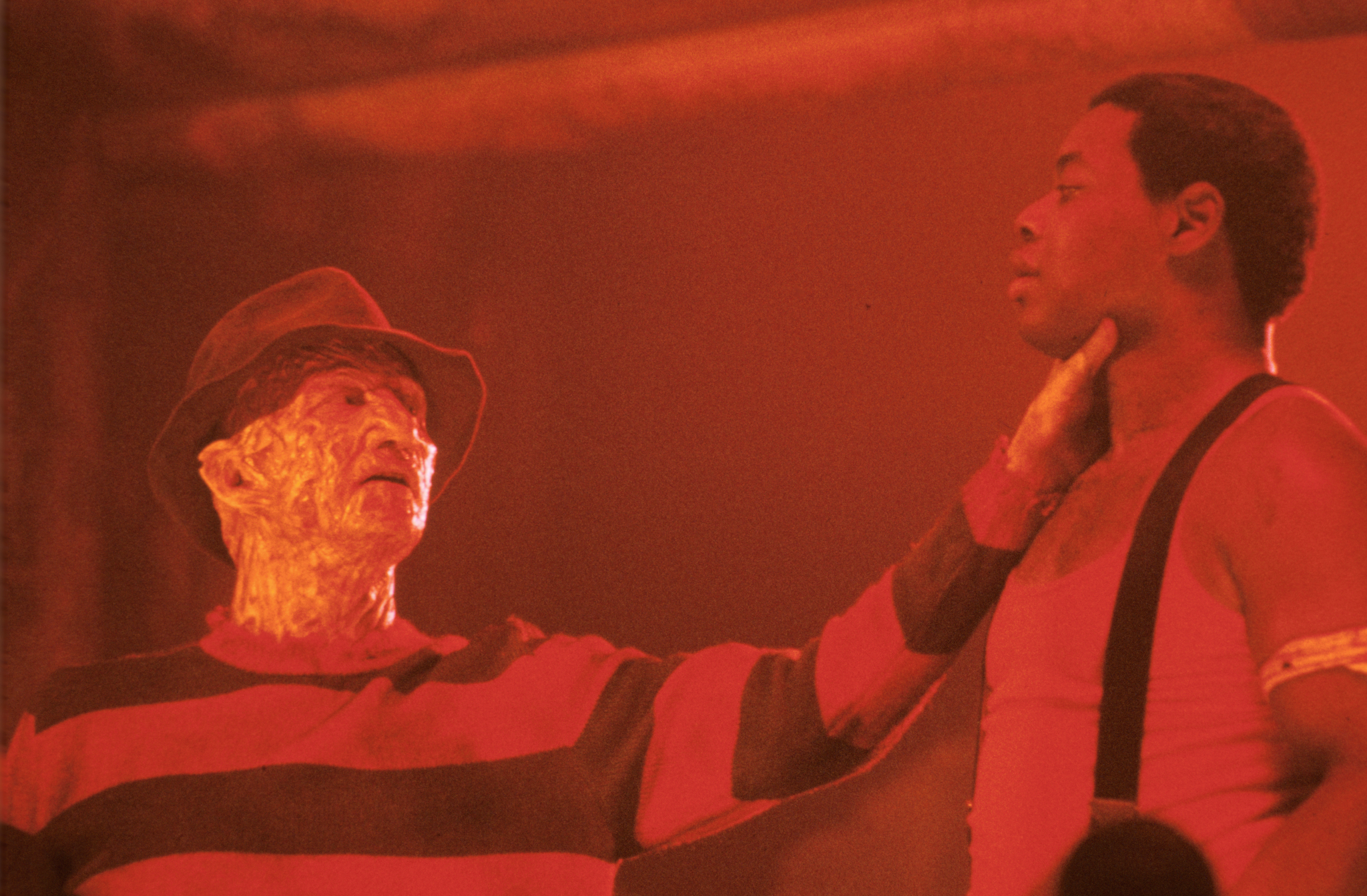
"For the last time, it was a shaving accident"

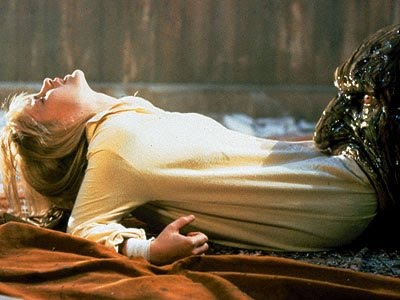
The deaths are also among the most varied and memorable in Nightmare lore. One telly-addicted victim pegs it when her TV sprouts a Freddy head and arms, picks her up and slams her head into the screen, while another nearly meets her end at the hands (well, gums) of a giant Freddy snake which looks not unlike a huge penis. Not that I noticed, I’m just saying.

By far the most talked-about scene in the film however is the puppet suicide. One of the patients builds puppets as a hobby and so Freddy uses this against him by ripping his veins out of his wrists and feet and turning him into a giant puppet, using the veins as strings and operating him from above. To everyone else it looks like he’s just sleepwalking, but in his dream Freddy is in control, leading him to the top floor and chucking him out the window in what appears in the real world to be a suicide.

Even the film’s ending is effective, as some characters you expect to live don’t make it and Freddy’s demise actually makes some sense given his religious bloodline. It’s an appropriate end, and had the series finished there it would have been a fitting way to draw a line under things and atone for the poor second film. Of course, it didn’t quite happen like that, but that’s for another time.

If you want to watch only the best films in the Nightmare On Elm Street series then watch the first, skip the second and definitely check out Dream Warriors. It’s second only to the original movie in terms of plot and creativity while also presenting a Freddy that, while more charismatic, is still somewhat scary. In short, it was the last truly fantastic film in the main Nightmare On Elm Street series.

Usually I end my reviews with the film’s trailer but the Nightmare On Elm Street 3 one was only a sort of teaser trailer, effective though it may be:

So to give a better idea of the movie I found this fan-made trailer which is actually really well-made and gives a fantastic sense of what the film’s all about. I really recommend it because it goes some way to explaining why I love this film so much. Enjoy!

Rubber (2010)

Director: Quentin Dupieux

Starring: Stephen Spinella, Jack Plotnick, Wings Hauser, Robert The Tyre

“My God, the kid was right. The killer was the tyre.” (Liutenant Chad, Rubber)

Slasher movies often have bizarre killers. Child’s Play has a possessed doll, A Nightmare On Elm Street features a dream demon and Sleepaway Camp’s killer… well, that would be ruining it. Rubber blows them all away with easily one of the oddest villains in movie history – a rubber tyre.

For no reason whatsoever (something reinforced in no uncertain terms during the film’s opening monologue), the film mostly follows a car tyre happily rolling down a desert road, killing anything it meets. At first it simply crushes things – a scorpion, for example – but soon it encounters a plastic bottle and realises that not everything can be destroyed by rolling over it. This is when it shows its hidden ability, the ability to make things explode using the power of its mind.

It may not look it, but this stand-off is one of the best scenes in the film

As it continues its trail of destruction the tyre starts offing humans as well, using its psychokinetic powers to make their heads explode in a shower of brains and gore. Why? It’s never explained.

As fun as the concept for Rubber is, it would be very difficult to make something like this last for 80 minutes on its own. That’s why there’s a bizarre sub-plot involving a crowd of people all standing in the desert, using binoculars to watch the same movie we’re watching. They discuss things that don’t make sense (in one scene the tyre rolls into a swimming pool and sinks to the bottom, at which point the group start arguing about the physics and whether it should have floated), they talk about what they think will happen next, and they generally add a bit of much-needed personality to a film where the mute main character is limited to rolling and making things explode.

Glastonbury had a poor turnout this year

It’s an unusual decision but a fun one too. It shows that the film realises the story of the rolling tyre makes very little sense, which is why this crowd of people are just as bemused as us, and when the joke starts to run thin they’re disposed of in a silly manner, allowing us to focus on the tyre again as it starts to outrun the police.

Rubber is a truly unique film, and one you really need to see to appreciate. There are times when the pacing is too slow and the ending leaves a lot to be desired, but get a few people who know nothing about it together and give it a watch and you’ll all be laughing at how ridiculous the whole thing is. Rubber is proof that any actor, no matter how lifeless, can play a lead roll (sorry).

The Human Centipede (First Sequence) (2009)

Director: Tom Six

Starring: Dieter Laser, Ashley Williams, Ashlynn Yennie, Akihiro Kitamura

“Do you already regret your little escape? In fact, I’m thankful for it, because now I know you are definitely the middle piece.” (Dr Heiter, The Human Centipede)

(Short note: this is a particularly nasty movie, and while there are no overly offensive screens in this review there’s a little colourful language explaining some of the more controversial scenes. If you get queasy just reading about bodily fluids and medical experiments, let alone seeing them, it might be best to give this one your own zero-star rating and move on.)

There are plenty of positions in life that it would be best to avoid. Being in goals for San Marino when you’re playing Brazil at football would be one of them. Being the man in charge of cleaning up after an orgy would be another. There’s one position however that’s probably worst of all, and that’s being the middle piece in a human centipede. The reason for this will become obvious later.

Christopher Walken just didn't suit white

The Human Centpiede opens with two attractive young American women getting lost on the way to a party in Germany when suddenly their car breaks down. They wander through the woods until they finally reach a huge house and when they ring the doorbell an odd chap answers and lets them in. So far so shamelessly stolen from The Rocky Horror Picture Show, but what follows makes Rocky Horror‘s transvestite shenanigans seem about as shocking as someone blowing their nose.

The man, a stony-faced German chap called Dr Heiter (Laser), offers the girls some water. They accept and realise it’s been spiked, but it’s too late and when they wake up they find themselves strapped to hospital beds.

In fairly graphic detail, the doc explains to the girls along with a third prisoner (a Japanese man) that he wants to create a human centipede – a single organism made up of three people. He’ll do this by joining up one person’s mouth to the anus of another, and then joining the other’s mouth to a third person’s anus. In that way, all going well, the three will work together as one functioning body.

Good job he doesn't know PowerPoint

Surprisingly, despite that previous paragraph, The Human Centipede isn’t very disturbing to watch, at least not with regards to what actually appears on screen. Much like Psycho and the Texas Chainsaw Massacre, The Human Centipede plays on the notion that the viewer’s imagination is much more powerful than anything film can show. In actual fact, the film shows nothing graphic relating to the experiment other than around 20 seconds of operation footage where the doc cuts a slice out of someone’s bum. Movies like Saw and Hostel, which explicitly show body parts being sliced, stabbed and crushed, are a million times more visceral and graphic.

Indeed, mercifully (or more likely simply thanks to budget constraints), each person in the centipede wears a sort of nappy so as to block the view of the actual mouth-to-rump connection, leaving what it looks like entirely within the confines of your own mind. This extends to the most grotesque scene in the film where the Japanese chap, having eaten some food laced with laxatives earlier, realises he suddenly has to (to put it politely as possible) dispose of his waste. Though you never see anything, the thought of what’s going on in that poor middle woman’s mouth is enough to put a bad taste in your own. Simply put, this film is more likely to shock you if you have a vivid imagination.

"We'll get that panto horse gig if it kills us"

Dodgy content aside, The Human Centipede is actually a fantastically shot film. The lighting is moody, the outdoor shots are atmospheric and Dr Heiter’s house is so geometrically unusual it’s almost a character in its own right. Had it not been for the small matter of people with their gums wrapped round each other’s arses it could even be considered beautiful. While it seems the soon-to-be-released-unless-you’re-British Human Centipede 2 may not be quite so artistic (we’ll see in a future review… if I can get hold of it), there’s no denying it would be unfair to pass this first film off as low-budget trash simply because of its tasteless subject matter.

Also stunning is Dieter Laser’s performance as the insane doctor. He’s like Christopher Walken with the intensity turned up so far the dial has broken off, and is simply terrifying to both see and hear.

If the mere thought of what happens in The Human Centipede makes you feel physically ill then this film clearly isn’t for you. Many of the scenes, while not graphic, will still give enough information to get your mind working and make for very uncomfortable viewing.

If, however, you’re intrigued by the concept but are simply worried about what you may see than by all means watch it. It is nowhere near as visually horrifying as you may have heard and if the only thing holding you back is the fear of what is shown rather than what is simply implied then there’s very little to be concerned about. Either way, this is a far more accomplished, professional film than some of its critics would have you believe.

Dangerous Worry Dolls (2008)

Director: Charles Band

Starring: Jessica Morris, Meredith McClain, Deb Snyder

Also known as: Dangerous Chucky Dolls (UK DVD)

“Worry dolls. You gotta be fuckin’ kidding me.” (Alexis, Dangerous Worry Dolls)

Full Moon Features are known for their incredibly low-budget horror movies and, as spoofed in Gingerdead Man 2, many of these involve dolls. The likes of Puppet Master and Demonic Toys were very successful for Full Moon, so it’s no surprise that they’d want to continue trying their hand at something similar. Despite its name, Dangerous Worry Dolls isn’t really that sort of film. At least, not at first.
It’s set in a young women’s reform institute (essentially a very low-security prison), where Eva (Jessica Morris) has been sent for killing someone. Eva just wants to serve her sentence without any hassle so she can get out quick and be with her young daughter again, but she”s getting hassle from Killa Kim, a drug smuggler who wants her to be her mule. Even worse, the militant cow who runs the institute isn’t listening to Eva’s complaints because she “knows her type” and doesn’t think she’s capable of turning over a new leaf.

"Morning, chief"

Eva’s luck changes when her daughter comes to visit and gives her some worry dolls, tiny little voodoo-like skeleton dolls who come in a dinky coffin-shaped box. Her daughter explains that if she puts the worry dolls under her pillow as she sleeps, all her worries will go away. After being sexually assaulted by one of the guards (off-camera, thankfully), Eva reaches the end of her tether and lays the worry dolls under her pillow, hoping they’ll help. As she sleeps they come alive and crawl inside her ear, and that’s where it starts getting a bit odd.

The worry dolls give Eva renewed confidence, so she starts dishing out kickings and the odd murder to the other girls and staff in the facility. She also grows a spot in the middle of her forehead, a spot that continues to grow until eventually a tiny skull comes out of her forehead, squealing like a pig. Incredibly, thanks to the poor acting on display, hardly any of her fellow inmates pay any attention to this screaming forehead-skull, seemingly unimpressed by it and completely undermining the impact of the film.

It was tricky trying to get One Direction ready for performance

Perhaps the most shocking thing about Dangerous Worry Dolls is that its sole great performance is the lead role, played by Jessica Morris, an actress I once described as “consistently wooden” in my review of the shitefest that was Scream Bloody Murder. She’s greatly improved in the years since that abomination, and she delivers her lines just right. It’s just a shame that, this time around, it’s the rest of the cast letting her down.

Dangerous Worry Dolls is dull. Its deaths mainly happen off-screen, its characters (with the exception of the lead) are more or less universally hateable, the “twist” scene involving one of the guards is just a complete cringe for all involved and the titular dolls are about as terrifying as dropping 5p. Despite its dramatic title, this is one film you really shouldn’t worry about.

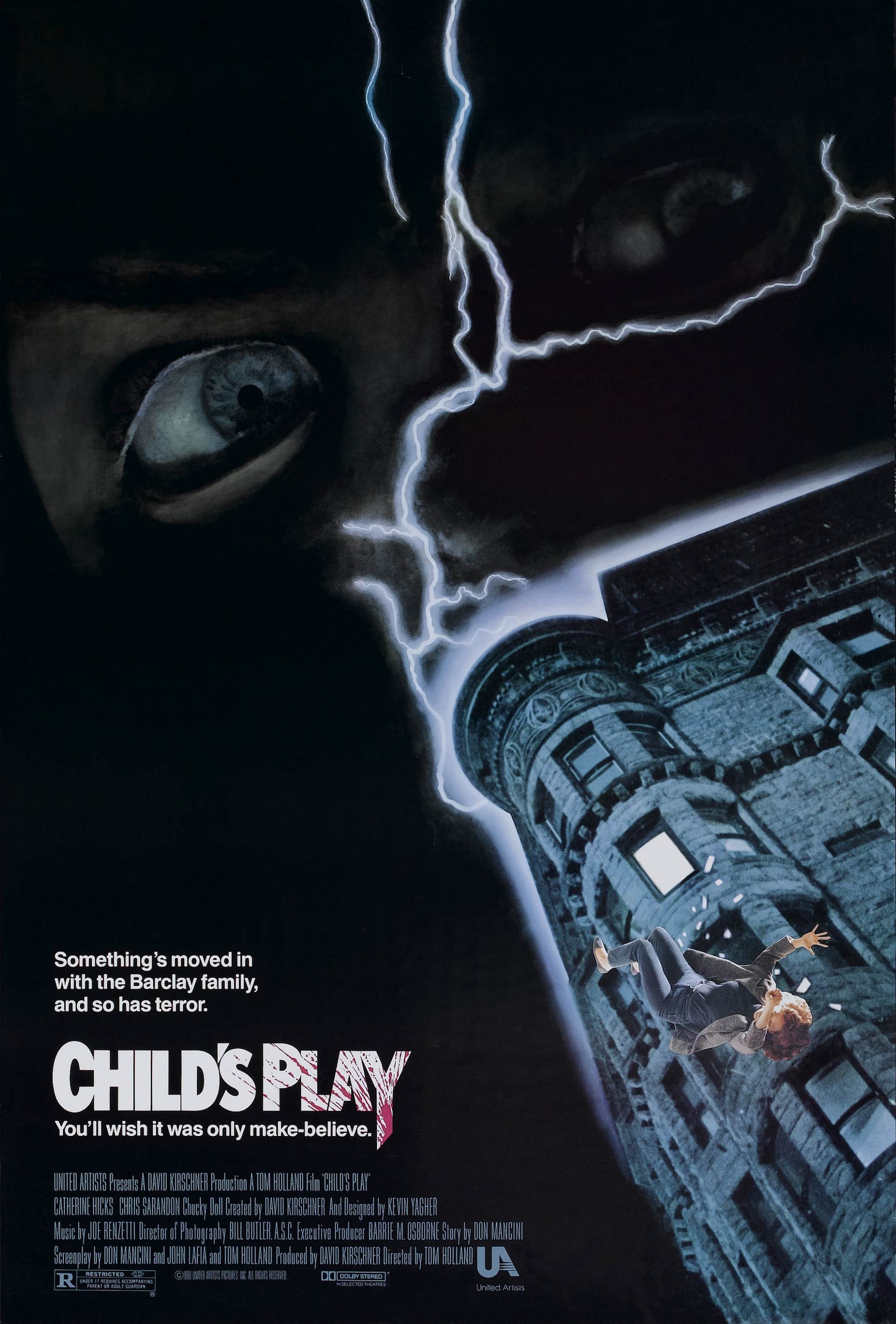
Child’s Play (1988)

Director: David Kirschner

Starring: Brad Dourif, Catherine Hicks, Alex Vincent, Chris Sarandon

“Hi, I’m Chucky. Wanna play?” (Chucky, Child’s Play)

It’s hard to truly appreciate Child’s Play nowadays, since the first 40 minutes of the film are completely ruined. When it was first released it was genuinely chilling, a gripping whodunnit with a paranormal twist. Of course, nowadays everyone already knows ‘whodunnit’ and so the first half of the movie is spent waiting for the film’s characters to catch up and find out what the rest of the world already knows – that the killer is a doll.

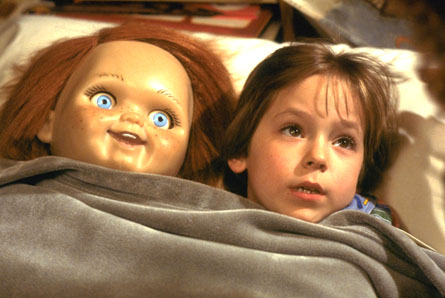
Poor little Andy (the adorable Alex Barclay) wanted a Good Guy doll for his birthday, but his mum couldn’t afford one so she just got him clothes and a shitty Good Guys tool kit instead. Noticing his disappointment, Andy’s mum thinks she’s struck it lucky later that day when a peddler near her work is selling knock-off Good Guy dolls stolen from a burnt-out toy shop. She buys one for $30 and is suddenly the greatest mum in the world again.

"And you're sure this operation will work doctor? I really don't want to be a Siamese twin any more"

This doesn’t last, because it soon emerges that this particular doll is possessed by Charles Lee Ray (Brad Dourif), a serial killer and voodoo nut who transforms his soul into the doll just before he’s killed by a police officer. The doll, Chucky, sets about killing Andy’s babysitter as well as the other criminal chaps who screwed him over before his ‘death’. Cue various explosions and voodoo doll stabbings.

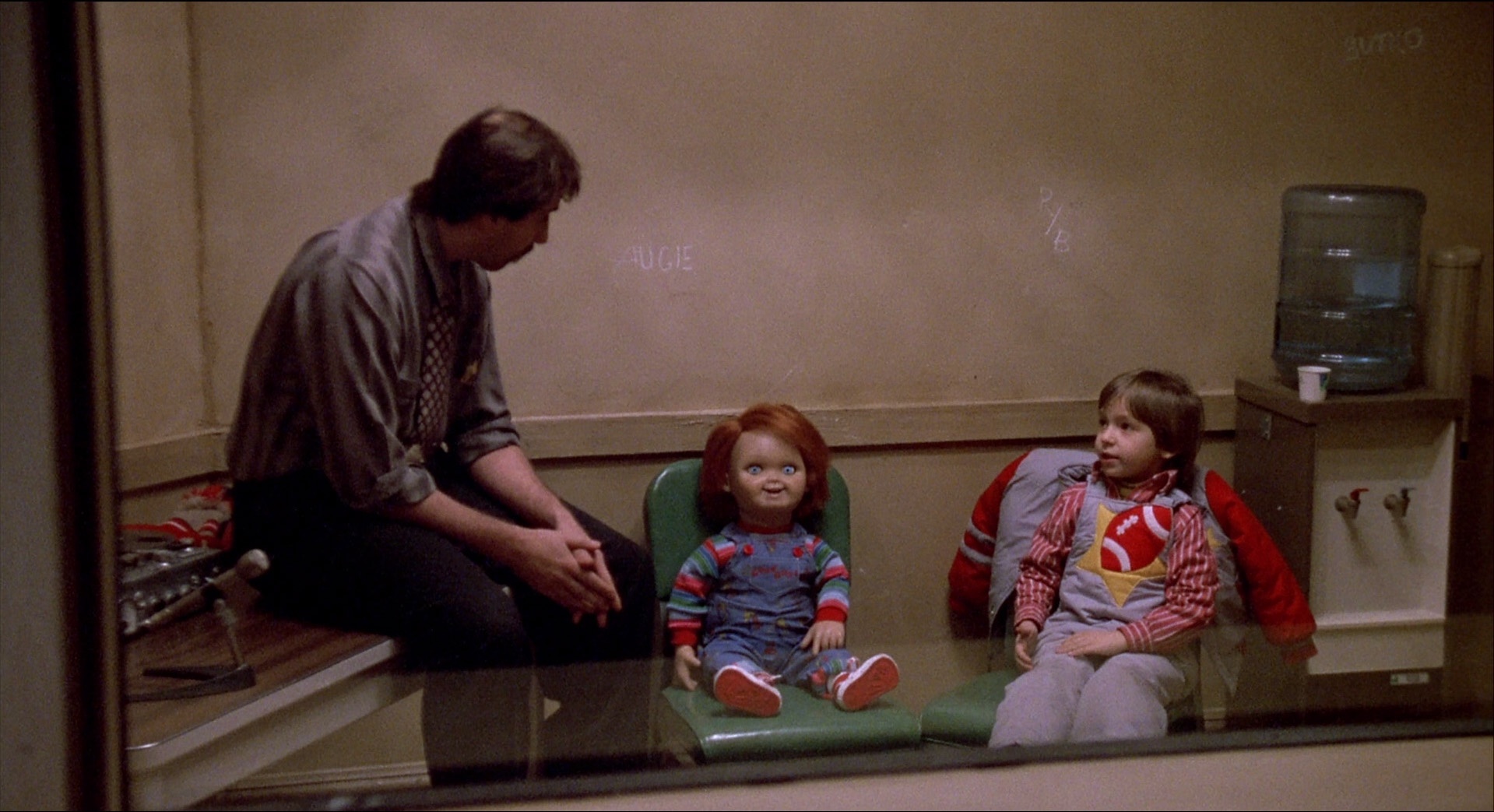
Since it’s the first film, the audience isn’t supposed to know Chucky is the killer. There are plenty of moments where it’s suggested (he leaves footprints on a table, seemingly blows up a building and so forth), but every time someone’s killed Andy’s close by, leaving some doubt in the audience’s mind – isn’t it just Andy doing the killing and blaming it on his doll?

Chucky was amused at the dog licking its balls in the room opposite

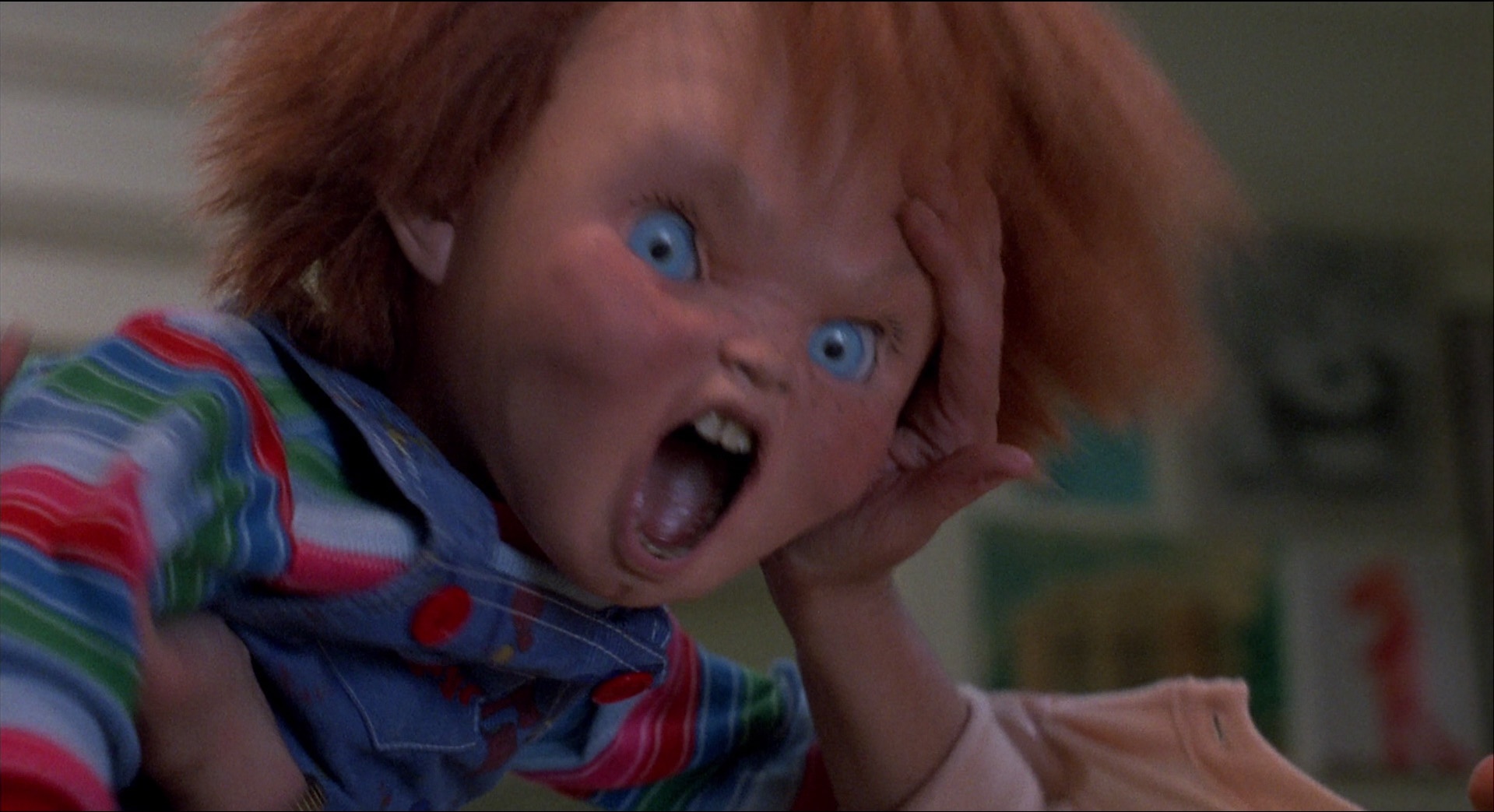
The special effects used to create the Chucky doll vary in quality throughout the film. In some scenes where Chucky speaks – most notably when he talks at length with his former voodoo mentor – the lip-syncing doesn’t really work too well due to the limitations of the robotics in the face and as such the illusion is shattered a bit. Other shots, particularly the far ones where Chucky is instead a midget actor wearing a Chucky mask, are far more effective and much creepier because the realistic movement makes it look more like a human in a doll’s body.

Child’s Play shouldn’t really have taken off the way it did. While the cast all put in great performances the kills are fairly dull and the two “he’s dead, or is he” endings are just silly to watch. The reason it was a success, and rightly so, is that Chucky is a fantastic movie monster. He’s a child’s best friend one minute, a foul-mouthed strangler the next and since his target victim is a six-year-old boy there’s something very sinister to him.

"Stop checking my ruddy temperature Margaret, I said I'm fine woman"

In a way, it was Child’s Play‘s own success that ultimately ruined the first movie’s impact. Once Chucky became a household name and every knew Child’s Play as “the film with the killer doll”, it instantly rendered the film’s first 40 minutes useless. Nowadays even the DVD cover has a big photo of Chucky brandishing a knife, making sure you definitely know what the surprise is just in case you’ve managed to avoid it.

If you’re able to forget for a while that Chucky’s the killer and can try to watch the film in its original context, Child’s Play is good fun. Otherwise, the sequels are better because they kick off with the Chucky action right from the start and don’t spend half the movie trying to make you guess what you already know.

Gingerdead Man 2: The Passion Of The Crust (2008)

Director: Silvia St Croix

Starring: Joseph Porter, Kelsey Sanders, K-Von

“Rise, Haunted Dildo! RIIIIIISE!” (Lord Astroth, Gingerdead Man 2)

We all know the vast majority of sequels are worse than their predecessors, but when the original film in question is The Gingerdead Man then there isn’t much needed to break that rule. Sure enough, while Gingerdead Man 2 isn’t exactly a great movie, it still manages to do enough to surpass the first movie in the entertainment stakes.

Ironically, the best bits in Gingerdead Man 2 are the ones that don’t feature the titular brutal biscuit at all. The majority of the film has little to do with the tiny killer (no longer played by Gary Busey, who seemingly got his mind back), instead focusing on the story of Cheatum, a film studio losing money as it continues to churn out crap horror sequels.

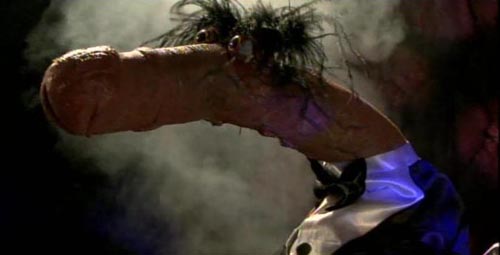
The terrifying Haunted Dildo. And by terrifying I mean awesome.

As a film created by Full Moon, a studio notorious for creating many atrocious horror franchises like Killjoy, Puppet Master and, of course, Gingerdead Man, this movie is essentially Full Moon’s attempt to make fun of itself and say “look, we know we make shitty movies, but that’s why people love us”. The most obvious example of this is the Tiny Terrors, a bunch of crappy puppets starring in a zero-budget horror film the studio is shooting, which are clearly a nod to the countless puppet-related films Full Moon have made in the past – Puppet Master, Demonic Toys, Dollman, Dangerous Worry Dolls and so forth. The Tiny Terrors are hilariously bad creations, though in this way the likes of Shit-For-Brains (a baby doll with poo dripping down its head) and Haunted Dildo (a big floppy penis wearing a suit) have won my heart.

The rest of the Tiny Terrors, the surprise stars of this film

The rest of the film is filled with little in-jokes and cameos from past cult horror stars (special effects guru Greg Nicotero and Michelle Bauer, one of the original scream queens, make appearances, and directors John Carl Buechler and David DeCoteau also have self-deprecating cameos) that will please Full Moon fans, but they’re subtle enough that others won’t notice them and feel left out.

The acting, as expected, is horrible. There’s some primary school play level stuff going on here at times however it does add to the film’s deliberately cheesy atmosphere. The only highlights are the hideously-named K-Von as the studio’s owner and Kelsey Sanders as a volunteer with a Make-A-Wish-type charity. Joseph Porter, who plays a wheelchair-bound Cheatum devotee with a curious secret, is above and beyond the worst of a bad bunch, but while the film’s dodgy twist ending goes some way to explaining this it’s not really an excuse.

Whatever mate, you're no match for Haunted Dildo. On your way.

And then, of course, there’s the Gingerdead Man himself. For the first part of the film he does very little, generally fannying about while swearing at things and not being noticed by anyone. He does get his hands dirty once or twice during the film with some ropey murder scenes, but for the most part he’s the least interesting thing about the film. The final fifteen minutes more or less confirms that the filmmakers felt the same way, since a different enemy takes centre stage and the crazed cookie is more or less ignored. It’s only in his death scene, which is more than a little blasphemous, that he actually feels like the star of the movie.

There’s no need to see the original Gingerdead Man, but if you fancy a self-aware film that’s deliberately cheap and nasty and makes fun of itself for being so, then give this a go. It’s certainly not great, but fair play to Full Moon for managing to polish a turd a little.

Dinoshark (2010)

Director: Kevin O’Neill

Starring: Eric Balfour, Iva Hasperger, Roger Corman

“You’re gonna need a bigger chopper, cabron.” (Trace, Dinoshark)

There are officially somewhere in the region of three and four billion movies about dangerous animals that have been mutated a little, so Dinoshark would have to do something special to gnash its way to the top of the list. It doesn’t.

The film opens with a shot of a baby Dinoshark breaking free from an Arctic glacier that’s been melting (damn you global warming, etc). Obviously ice acts just like a cryogenic chamber because despite having been frozen for millions of years the baby Dinoshark is alive and well. Fast forward a few years and the older, wiser, hungrier Dinoshark has made its way to Puerto Vallarta in Mexico – hey, you’d head for the sun too if you’d been trapped in ice for that long – and is looking to chew on some Mexicans.

The Sausage Killer strikes again, but not before leaving his calling card

Who can stop the Dinoshark? Unfortunately, the answer to that question is suave dickhead Trace McGraw, one of the least likeable heroes in cinematic history. Trace thinks he’s the greatest man who ever lived, but nobody really believes his stupidly exaggerated stories about the adventures he’s been up to since he was last in Mexico. When he sees the Dinoshark ripping a fellow boater to shreds, then, people laugh and tell him he’s making it up.

You see this same shot about eight times throughout

They’re not laughing so much when the Dinoshark starts attacking other people near the beach, mauling swimmers, children and water polo players in a mess of blood and unconvincing CGI, and so off goes Trace to give it a swift kicking.

The quality of the acting in Dinoshark is so bad it actually made me angry to think there are struggling actors out there trying to get a gig while pricks like these are stinking up celluloid. The only decent performance is from cult film producer Roger Corman (who also produced this – how the mighty have fallen). He plays a small role as a scientist and is the only believable thing in a film with an obviously unbelievable plot.

It’s a shame that the best thing about Dinoshark is the title. It’s not well-made enough to be surprisingly adept and it’s not cheesy enough to be a guilty pleasure. It’s just badly made from start to finish and really not worth bothering with. This one should have stayed frozen – just watch the trailer below, have a chuckle, know that you’ve seen the only good bits and move on.

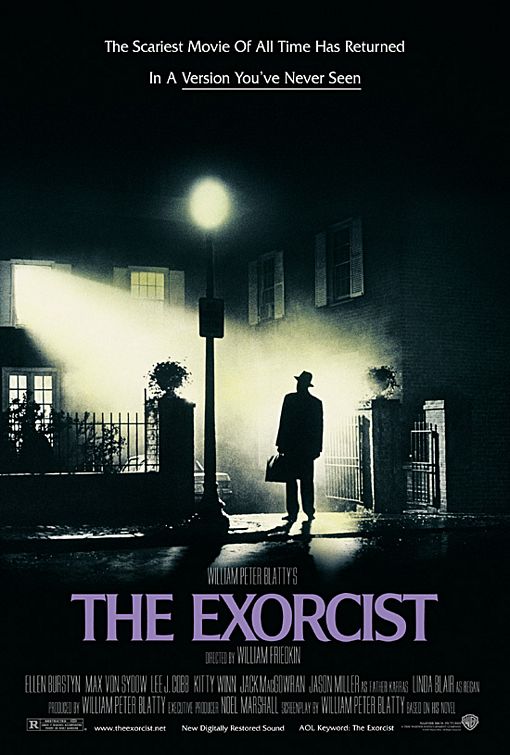
The Exorcist: The Version You’ve Never Seen (2000)

Director: William Friedkin

Starring: Linda Blair, Ellen Burstyn, Jason Miller

“I think the point is to make us despair. To see ourselves as animal and ugly. To make us reject the possibility that God could love us.” (Father Merrin, The Exorcist: The Version You’ve Never Seen)

(Note: if you haven’t read my review of The Exorcist yet, it may be best to check it out first.)

Although The Exorcist was a worldwide smash hit and remains Warner Bros’ highest-grossing film at the box office (after inflation), William Peter Blatty remained unsatisfied. As the author of the book on which the film was based he felt some key scenes had been dropped, scenes that would have given viewers the message he originally wanted to express.

William Friedkin, the film’s director, disagreed. He felt the film worked perfectly as it was and told Blatty he was being “a bad winner”, that they were both making a fortune on a hugely critically successful film and he should be happy with the recognition. The two fell out for a while because of this dispute.

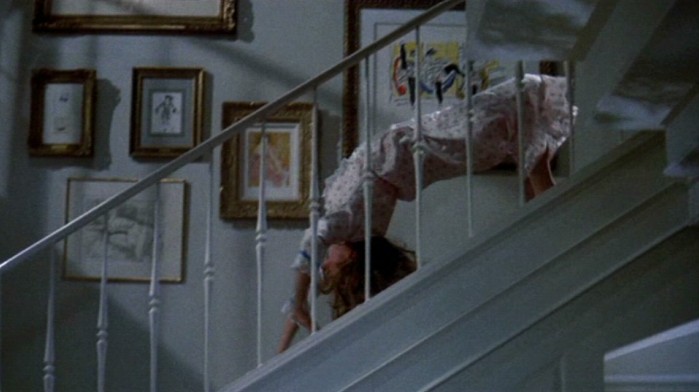
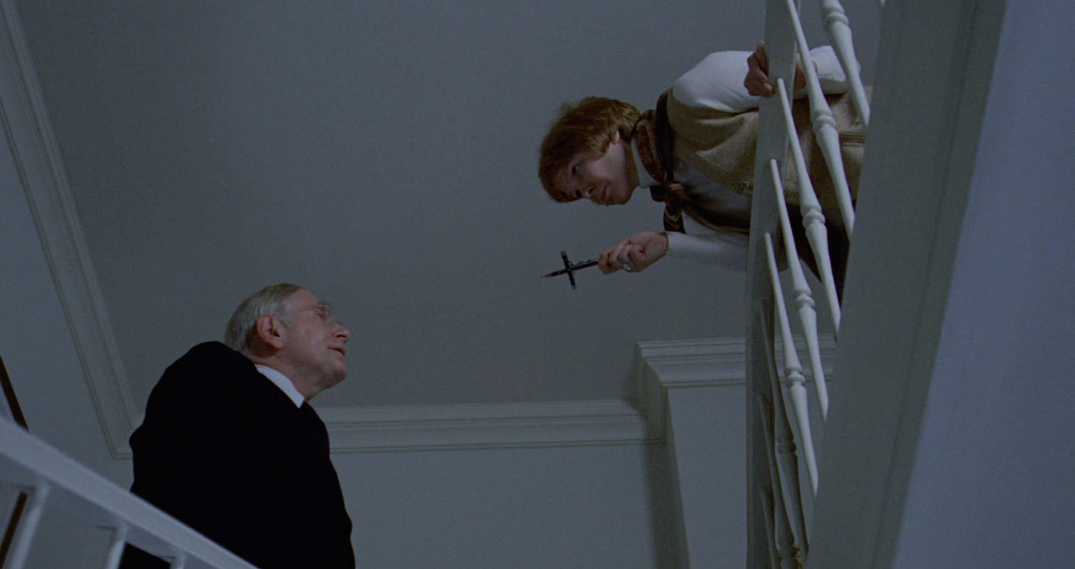
"I told you to take your toys off the stairs, now look what's happened"

Time passed and Blatty and Friedkin resolved their differences and became friends again. Blatty still maintained that he wasn’t happy with parts of the film, in particular the ending, which he felt ended too ambiguously and left people leaving the cinema on a downer thinking the devil may have won. Friedkin remained unconvinced, and maintained that the film should stay untouched.

Some other subtle CGI effects (like this face morph) were added to the film

Eventually, around the time of the film’s 25th anniversary, Blatty persuaded Friedkin to dig out the unused footage from the film and put together a new cut of The Exorcist that more closely resembled Blatty’s original vision, a sort of ‘Writer’s Cut’. The result was released in cinemas in 2000 as The Exorcist: The Version You’ve Never Seen.

Despite Blatty’s original intention for the re-release, the most notable change in this new cut is the inclusion of the legendary ‘spider walk’ scene. This deleted scene, in which Regan flips upside-down and walks down the stairs like a spider, had been part of Exorcist lore for years with fans eager to see it as it was originally intended. The scene itself is pretty effective – here it is if you fancy a gander:

So, the spider walk aside, what else is in there? Well, the other main addition is of course the aforementioned alternative ending, which involves an extra scene at the end where Father Dyer and Lt Kinderman have a pleasant chat. This was the scene Blatty wanted to add to reassure the viewer that all was well with the world, and I could take it or leave it really.

There are also a few little trims and additions dotted here and there throughout the movie. Father Merrin has a few extra scenes with Chris MacNeil and Father Karras which flesh his character out a little, and there are some new digital effects where a demon’s face subliminally pops up from time to time.

Do these changes make The Version You’ve Never Seen a better movie than the original? Not necessarily, it just makes it a slightly different one that perhaps feels slightly more modern. Both versions are effective but if pushed I’d recommend you watch the spider scene above then just check out the original version of the film, since its more ambiguous ending leaves a greater feeling of unease.

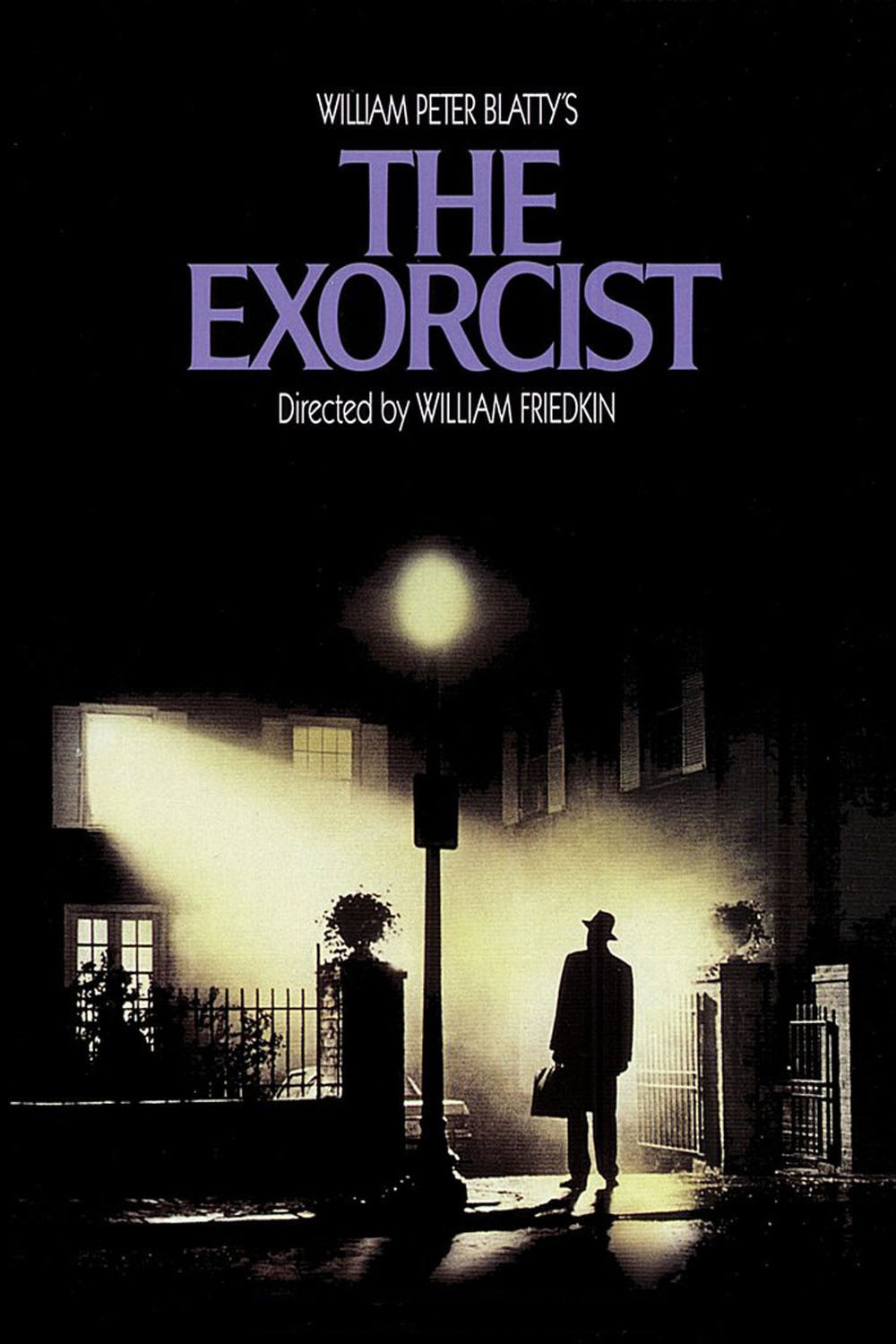
The Exorcist (1973)

Director: William Friedkin

Starring: Linda Blair, Ellen Burstyn, Jason Miller

“Mother, what’s wrong with me?” (Regan, The Exorcist)

The Exorcist is not a horror film. At least, that’s what director William Friedkin, writer William Peter Blatty and Linda Blair, who played the possessed little girl in the film, would have you believe. According to them, it’s a drama about the mystery of faith that just happens to have disturbing scenes in it. Personally I’d chuck a stern “bullshit” at that theory, but it doesn’t really matter. What’s important is that whatever genre or niche you try to place it in, The Exorcist remains one of the greatest films ever made.

The story’s well-known, but for those who’ve maybe managed to avoid it I’ll fill you in on the basics. Chris MacNeil (Burstyn) gets concerned when her little girl Regan starts showing some odd behaviour. She pees on the carpet, swears at doctors and starts playing with ouija boards. While this may be the normal sort of behaviour you’d expect from an Essex youth, for the well brought-up Regan it’s very uncharacteristic.

"You might want to run this under the tap first, it's been... um, used"

Doctors are unable to figure out what’s wrong with Regan and brain scans come back negative, suggesting she’s not suffering from any sort of mental illness. Meanwhile, Regan’s behaviour gets more and more shocking, culminating in her slapping her mother across the face and ramming her head into her crotch. Remember, not from Essex.

It soon emerges that Regan claims to be possessed by the devil so, at her wit’s end, Chris goes to a local priest and asks him to arrange an exorcism. After a bit of persuasion (mainly involving Regan masturbating with a crucifix and spinning her head 360 degrees), he decides to get in touch with Father Merrin, one of the few Jesuit priests who still perform the rare ritual. Can they drive the devil out of Regan? That would be telling.

Critics felt the latest Derren Brown show had gone a little too far

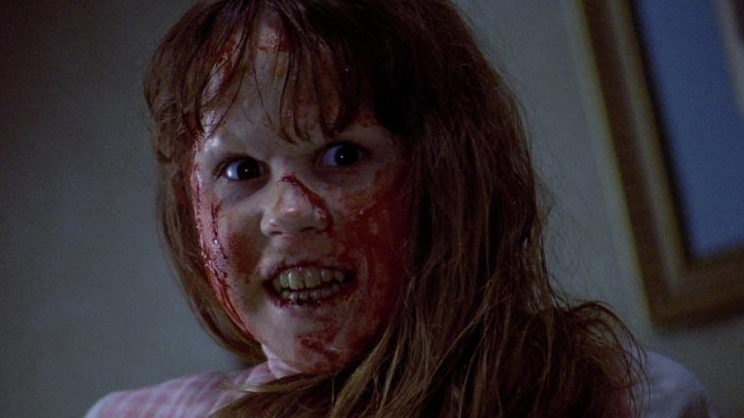
While its key moments have been parodied time and time again, spoofed by the likes of the Wayans brothers in Scary Movie 2, Leslie Nielsen in Repossessed and even a Danish bacon advert, The Exorcist still has the power to shock. This is mainly due to two things – the believable and realistic special effects and the superb performance by Linda Blair as Regan.

Regan is such a likeable, idyllic little girl at the start of the movie that when she descends into her possessed state and starts saying and doing the most outrageous things it’s all the more shocking. You find yourself siding with her mother as she tries to get help – you care about this once-sweet little girl’s well-being and you want her to overcome this demon who’s possessed her. Had Regan not been so easy to warm to at the start then the audience would have made less of an emotional investment in the movie.

"What do you mean you forgot to buy my fucking Clearasil? It's the one bloody thing I wanted from the shop"

The effects, many of which have only been recently explained, are the work of genius. These days it suffers from the “Beatles effect” – the genre has evolved so much over the years (in this case thanks to CGI) that it can be hard to appreciate the impact it made when it was first released, but at the time it was doing stuff on camera that had never been seen before and without a computer in sight.

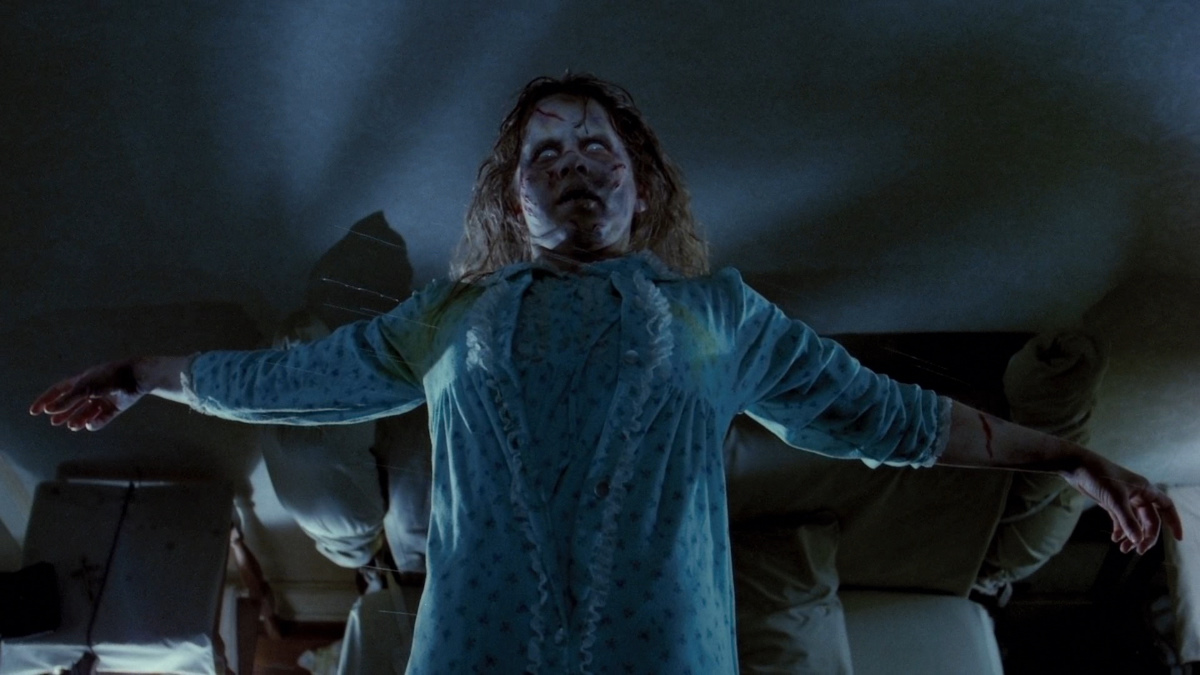
The bed shaking was handled by building a bed, cutting a hole in the wall behind it and having a crew of men literally shake the bed from behind the set. The famous levitation scene (where Regan rises from her bed) was done with wires painted grey and white in a dash effect to confuse the eye and make them impossible to see in the film. The spinning head was a robotic dummy, the vomit scene was created with a mouth attachment that fired pea soup… all pieces of technical genius and all remarkably believable.

You could watch The Exorcist ten times and get something new out of it each time you watched it. Legendary critic Mark Kermode famously said he’s watched it over 200 times and it still feels new to him every time. There are so many subtle moments, so many nods to events that will happen later on, so many different ways to consider each scene and so many different interpretations you can give to its open ending that everyone will take away something different from the film. Religious viewers will see the fear in having their faith challenged, parents will see the fear in the helplessness Chris feels as her daughter succumbs.

Whoever you are and whatever your beliefs may be, you really have to see this film. It may terrify you beyond belief (though if you’re a hardened Saw addict it may not), but it’s one of the most important films in cinema and a landmark of the horror genre – whether or not the filmmakers believe it’s a part of it.